第7章単位円:正弦関数と余弦関数The Unit Circle: Sine and Cosine Functions
Identifying the Domain and Range of Sine and Cosine Functions正弦関数と余弦関数の定義域と値域を見分ける
Now that we can find the sine and cosine of an angle, we need to discuss their domains and ranges. What are the domains of the sine and cosine functions? That is, what are the smallest and largest numbers that can be inputs of the functions? Because angles smaller than and angles larger than can still be graphed on the unit circle and have real values of and there is no lower or upper limit to the angles that can be inputs to the sine and cosine functions. The input to the sine and cosine functions is the rotation from the positive x-axis, and that may be any real number.
角の正弦と余弦が求められるようになったので、その定義域と値域を論じる必要がある。正弦関数と余弦関数の定義域は何か。つまり、この関数の入力になりうる最小の数と最大の数は何か。 より小さい角も より大きい角も、やはり単位円に描けて と の実数の値を持つので、正弦関数と余弦関数の入力になりうる角に下限も上限も無い。正弦関数と余弦関数の入力は正の x軸からの回転であり、それはどんな実数でもよい。
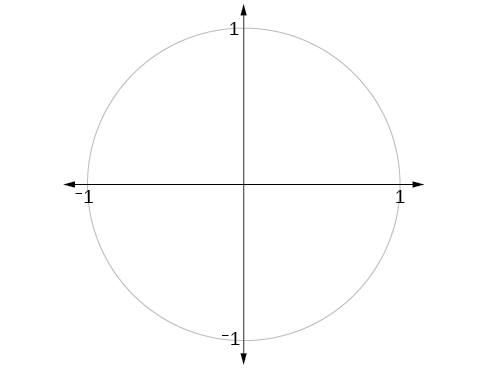
What are the ranges of the sine and cosine functions? What are the least and greatest possible values for their output? We can see the answers by examining the unit circle, as shown in Figure 15. The bounds of the x-coordinate are The bounds of the y-coordinate are also Therefore, the range of both the sine and cosine functions is
正弦関数と余弦関数の値域は何か。その出力の最小と最大の値は何か。図15に示すとおり、単位円を調べれば答えが見てとれる。x座標の範囲は である。y座標の範囲も である。したがって、正弦関数と余弦関数の値域はどちらも である。