第7章単位円:正弦関数と余弦関数The Unit Circle: Sine and Cosine Functions
7.1 Angles7.1 角
Learning Objectives 学習目標
In this section you will:
この節を終えると、次のことができるようになる。
• Draw angles in standard position.• Convert between degrees and radians.• Find coterminal angles.• Find the length of a circular arc.• Use linear and angular speed to describe motion on a circular path.
・標準位置に角を描く。・度とラジアンを相互に換算する。・動径が一致する角を求める。・円弧の長さを求める。・円運動を線速度と角速度で表す。
A golfer swings to hit a ball over a sand trap and onto the green. An airline pilot maneuvers a plane toward a narrow runway. A dress designer creates the latest fashion. What do they all have in common? They all work with angles, and so do all of us at one time or another. Sometimes we need to measure angles exactly with instruments. Other times we estimate them or judge them by eye. Either way, the proper angle can make the difference between success and failure in many undertakings. In this section, we will examine properties of angles.
ゴルファーがバンカーを越えてボールをグリーンに乗せようとする。パイロットが狭い滑走路に向けて機体を操縦する。ファッションデザイナーが新しい服をデザインする。これらに共通するのは、角度を扱うということだ。私たちも日常のさまざまな場面で角度を使っている。器具で正確に測ることもあれば、目分量で見当をつけることもある。いずれの場合も、適切な角度を選べるかどうかが結果を左右する。この節では、角の性質を調べる。
Drawing Angles in Standard Position標準位置に角を描く
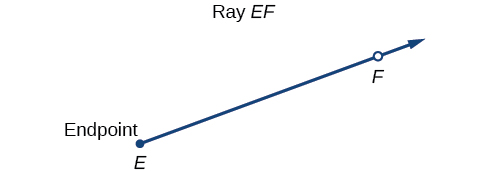
Properly defining an angle first requires that we define a ray. A ray is a directed line segment. It consists of one point on a line and all points extending in one direction from that point. The first point is called the endpoint of the ray. We can refer to a specific ray by stating its endpoint and any other point on it. The ray in Figure 1 can be named as ray EF, or in symbol form
角をきちんと定めるには、まず半直線を定める必要がある。半直線とは、一つの端点から一方向へ限りなく延びる直線の一部である。直線上の一点と、その点から一方向に伸びるすべての点からなる。この最初の点を半直線の端点という。ある半直線を指すには、その端点と、その上のほかの一点を述べればよい。図1の半直線は半直線 EF、記号では と名づけられる。
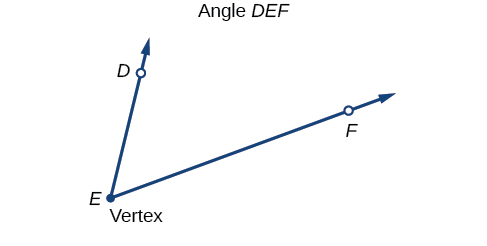
An angle is the union of two rays having a common endpoint. The endpoint is called the vertex of the angle, and the two rays are the sides of the angle. The angle in Figure 2 is formed from and . Angles can be named using a point on each ray and the vertex, such as angle DEF, or in symbol form
角とは、端点を共有する二つの半直線の合併である。この端点を角の頂点といい、二つの半直線を角の辺という。図2の角は と からできている。角は、各半直線上の点と頂点を使って角 DEF のように、あるいは記号で のように名づけられる。
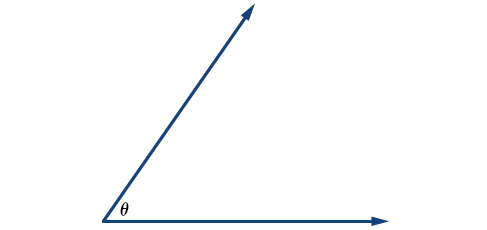
Greek letters are often used as variables for the measure of an angle. Table 1 is a list of Greek letters commonly used to represent angles, and a sample angle is shown in Figure 3.
角の大きさの変数には、しばしばギリシア文字が使われる。表1は角を表すのによく使われるギリシア文字の一覧で、角の例を図3に示す。
| or または | ||||
|---|---|---|---|---|
| thetaシータ | phiファイ | alphaアルファ | betaベータ | gammaガンマ |
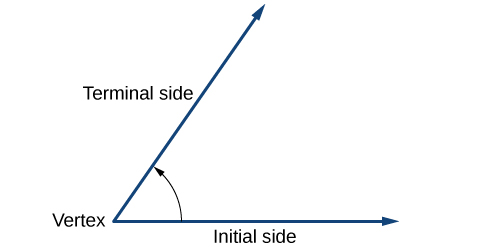
Angle creation is a dynamic process. We start with two rays lying on top of one another. We leave one fixed in place, and rotate the other. The fixed ray is the initial side, and the rotated ray is the terminal side. In order to identify the different sides, we indicate the rotation with a small arrow close to the vertex as in Figure 4.
角は、半直線を回転させることで捉えられる。まず2つの半直線を重ね、一方を固定して、もう一方を共通の端点のまわりに回す。固定した半直線を始線、回転後の半直線を動径という。図4のように、頂点の近くに小さな矢印を描くと、どちらの向きに回転させたかを示せる。
As we discussed at the beginning of the section, there are many applications for angles, but in order to use them correctly, we must be able to measure them. The measure of an angle is the amount of rotation from the initial side to the terminal side. Probably the most familiar unit of angle measurement is the degree. One degree is of a circular rotation, so a complete circular rotation contains degrees. An angle measured in degrees should always include the unit “degrees” after the number, or include the degree symbol For example,
この節の初めに論じたとおり、角には多くの応用があるが、それを正しく使うには角を測れなければならない。角の大きさとは、始線から動径までの回転の量である。角の大きさの単位として最もよく知られているのは、おそらく度である。1度は円の1回転の なので、円の1回転は 度である。度で測った角には、数の後につねに単位「度」を付けるか、度の記号 を付けるべきである。たとえば のようにする。
To formalize our work, we will begin by drawing angles on an x-y coordinate plane. Angles can occur in any position on the coordinate plane, but for the purpose of comparison, the convention is to illustrate them in the same position whenever possible. An angle is in standard position if its vertex is located at the origin, and its initial side extends along the positive x-axis. See Figure 5.
きちんと扱うために、まず x-y 座標平面に角を描くことから始める。角は座標平面のどの位置にも置けるが、比べるためには、できるかぎり同じ位置に描くのが決まりである。頂点が原点にあり、始線が正の x軸に沿って伸びているとき、その角は標準位置にあるという。図5を見よ。
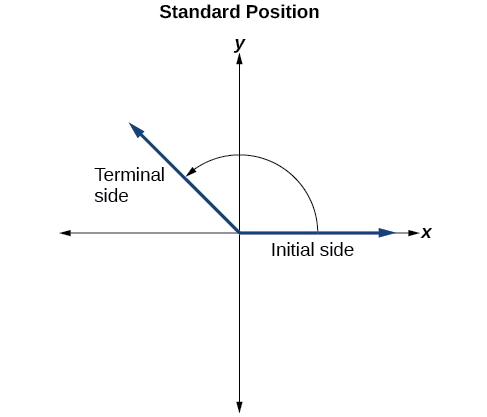
If the angle is measured in a counterclockwise direction from the initial side to the terminal side, the angle is said to be a positive angle. If the angle is measured in a clockwise direction, the angle is said to be a negative angle.
始線から動径まで反時計回りに測った角を、正の角という。時計回りに測った角を、負の角という。
Drawing an angle in standard position always starts the same way—draw the initial side along the positive x-axis. To place the terminal side of the angle, we must calculate the fraction of a full rotation the angle represents. We do that by dividing the angle measure in degrees by For example, to draw a angle, we calculate that So, the terminal side will be one-fourth of the way around the circle, moving counterclockwise from the positive x-axis. To draw a angle, we calculate that So the terminal side will be 1 complete rotation around the circle, moving counterclockwise from the positive x-axis. In this case, the initial side and the terminal side overlap. See Figure 6.
標準位置に角を描くとき、始め方はつねに同じである。正の x軸に沿って始線を描く。角の動径を置くには、その角が1回転の何分のいくつに当たるかを計算しなければならない。度で表した角の大きさを で割ればよい。たとえば の角を描くには と計算する。よって動径は、正の x軸から反時計回りに円を4分の1だけ回ったところになる。 の角を描くには と計算する。よって動径は、正の x軸から反時計回りに円をちょうど1周したところになる。この場合、始線と動径は重なる。図6を見よ。
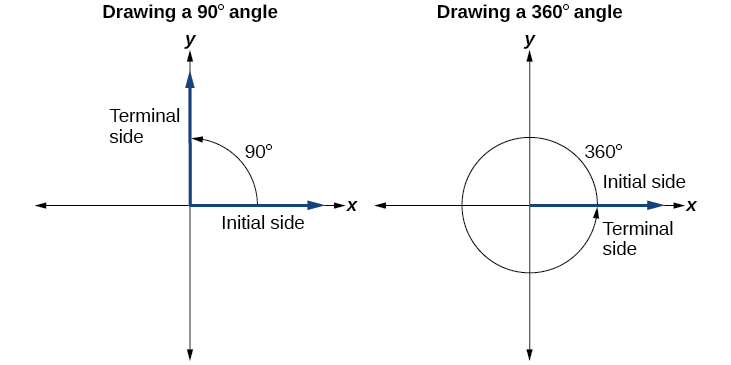
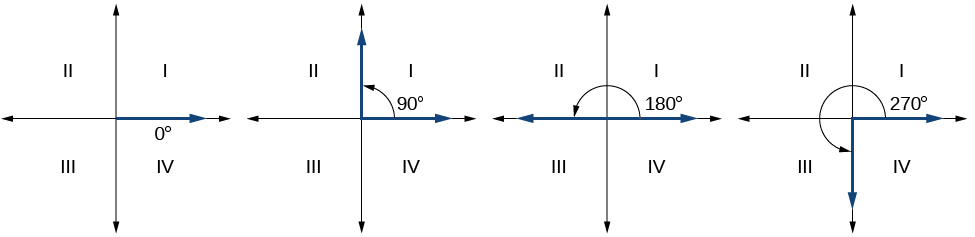
Since we define an angle in standard position by its terminal side, we have a special type of angle whose terminal side lies on an axis, a quadrantal angle. This type of angle can have a measure of 0°, 90°, 180°, 270°, or 360°. See Figure 7.
標準位置の角は動径で定めるので、動径が座標軸の上に乗る特別な種類の角がある。象限角である。この種の角の大きさは、0°、90°、180°、270°、360°のいずれかになる。図7を見よ。
Quadrantal Angles 動径が座標軸上にある角
An angle is a quadrantal angle if its terminal side lies on an axis, including 0°, 90°, 180°, 270°, or 360°.
角の動径が座標軸の上に乗るとき、その角を象限角という。0°、90°、180°、270°、360°がこれに当たる。
How To 手順
Given an angle measure in degrees, draw the angle in standard position.
度で表した角の大きさが与えられたとき、標準位置にその角を描く。
1. Express the angle measure as a fraction of 2. Reduce the fraction to simplest form.3. Draw an angle that contains that same fraction of the circle, beginning on the positive x-axis and moving counterclockwise for positive angles and clockwise for negative angles.
1. 角の大きさを に対する分数として表す。2. その分数を最も簡単な形に約す。3. 正の x軸から始め、正の角なら反時計回り、負の角なら時計回りに動いて、円のその分数だけの角を描く。
Example 1例1
Drawing an Angle in Standard Position Measured in Degrees度で測った角を標準位置に描く
ⓐSketch an angle of in standard position.ⓑSketch an angle of in standard position.
ⓐ の角を標準位置に描け。ⓑ の角を標準位置に描け。
Solution 解答
ⓐDivide the angle measure by To rewrite the fraction in a more familiar fraction, we can recognize that One-twelfth equals one-third of a quarter, so by dividing a quarter rotation into thirds, we can sketch a line at as in Figure 8. Figure 8ⓑDivide the angle measure by In this case, we can recognize that Three-eighths is one and one-half times a quarter, so we place a line by moving clockwise one full quarter and one-half of another quarter, as in Figure 9. Figure 9
ⓐ角の大きさを で割る。。この分数をもっとなじみのある分数に書き直すために、 であることに気づける。12分の1は4分の1の3分の1なので、4分の1回転を3等分すれば、図8のように のところに線が引ける。図8ⓑ角の大きさを で割る。。この場合、 であることに気づける。8分の3は4分の1の1回半なので、時計回りに4分の1を1回と、もう4分の1の半分だけ動いて線を引く。図9のようになる。図9
Try It #1やってみよう1
Show an angle of on a circle in standard position.
の角を、標準位置で円の上に示せ。
Converting Between Degrees and Radians度とラジアンを相互に換算する
Dividing a circle into 360 parts is an arbitrary choice, although it creates the familiar degree measurement. We may choose other ways to divide a circle. To find another unit, think of the process of drawing a circle. Imagine that you stop before the circle is completed. The portion that you drew is referred to as an arc. An arc may be a portion of a full circle, a full circle, or more than a full circle, represented by more than one full rotation. The length of the arc around an entire circle is called the circumference of that circle.
円を360に分けるのは恣意的な選び方だが、これでよく知られた度の測り方ができる。円を分ける別のやり方も選べる。別の単位を求めるために、円を描く過程を考えよう。円を描き終える前に手を止めたとしよう。描いた部分を弧という。弧は、円の一部でも、円全体でも、1回転を超える円より長いものでもよい。円全体に沿った弧の長さを、その円の周という。
The circumference of a circle is If we divide both sides of this equation by we create the ratio of the circumference, which is always to the radius, regardless of the length of the radius. So the circumference of any circle is times the length of the radius. That means that if we took a string as long as the radius and used it to measure consecutive lengths around the circumference, there would be room for six full string-lengths and a little more than a quarter of a seventh, as shown in Figure 10.
円の周は である。この式の両辺を で割ると、半径の長さに関わらずつねに である、周と半径の比が得られる。よってどの円の周も、半径の長さの 倍である。つまり、半径と同じ長さの紐をとって、周に沿って次々に長さを測っていくと、図10に示すとおり、紐6本分と、7本目の4分の1より少し多いだけの余地があることになる。
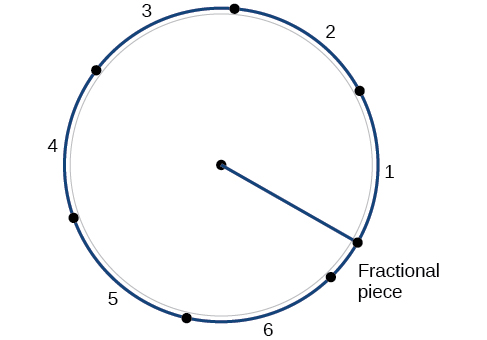
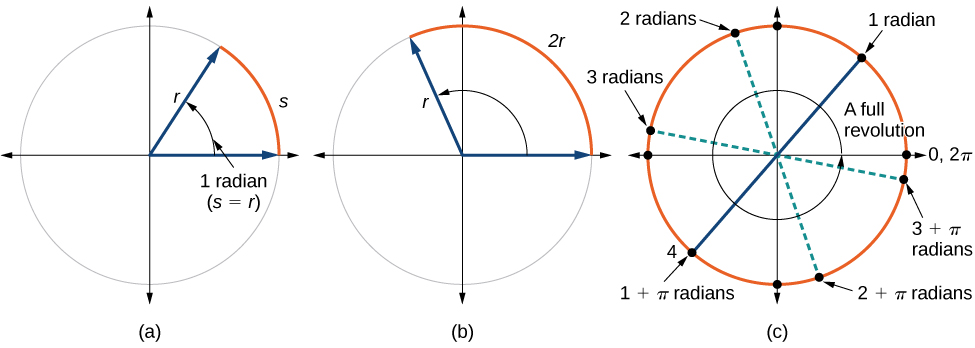
This brings us to our new angle measure. One radian is the measure of a central angle of a circle that intercepts an arc equal in length to the radius of that circle. A central angle is an angle formed at the center of a circle by two radii. Because the total circumference equals times the radius, a full circular rotation is radians.
これで新しい角の測り方にたどりつく。1ラジアンとは、円の半径と同じ長さの弧を切りとる、その円の中心角の大きさである。中心角とは、二本の半径によって円の中心にできる角である。周の全体は半径の 倍なので、円の1回転は ラジアンである。
See Figure 11. Note that when an angle is described without a specific unit, it refers to radian measure. For example, an angle measure of 3 indicates 3 radians. In fact, radian measure is dimensionless, since it is the quotient of a length (circumference) divided by a length (radius) and the length units cancel.
図11を見よ。角が単位を明記せずに述べられるときは、ラジアンでの大きさを指すことに注意せよ。たとえば角の大きさ3は3ラジアンを示す。実際、ラジアンでの大きさは無次元である。長さ(周)を長さ(半径)で割った商であり、長さの単位が消えるからである。
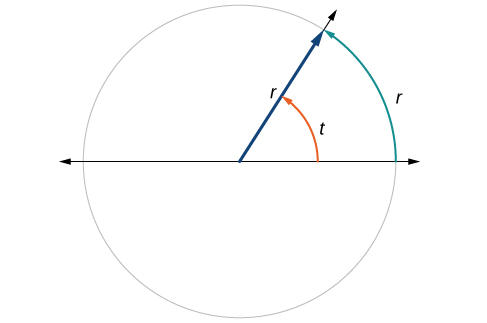
Relating Arc Lengths to Radius弧の長さと半径を結びつける
An arc length is the length of the curve along the arc. Just as the full circumference of a circle always has a constant ratio to the radius, the arc length produced by any given angle also has a constant relation to the radius, regardless of the length of the radius.
弧長 とは、弧に沿った曲線の長さである。円の周の全体がつねに半径に対して一定の比を持つのと同じく、与えられた角が生む弧長も、半径の長さに関わらず半径に対して一定の関係を持つ。
This ratio, called the radian measure, is the same regardless of the radius of the circle—it depends only on the angle. This property allows us to define a measure of any angle as the ratio of the arc length to the radius r. See Figure 12.
この比をラジアンでの大きさといい、円の半径によらず同じである。角だけに依るのである。この性質のおかげで、どの角の大きさも、弧長 と半径 r の比として定められる。図12を見よ。
If then
なら である。
To elaborate on this idea, consider two circles, one with radius 2 and the other with radius 3. Recall the circumference of a circle is where is the radius. The smaller circle then has circumference and the larger has circumference Now we draw a angle on the two circles, as in Figure 13.
この考えを詳しく見るために、半径2の円と半径3の円の二つを考えよう。円の周が であることを思い出そう。ここで は半径である。すると小さいほうの円の周は 、大きいほうの円の周は である。ここで、図13のようにこの二つの円に の角を描く。
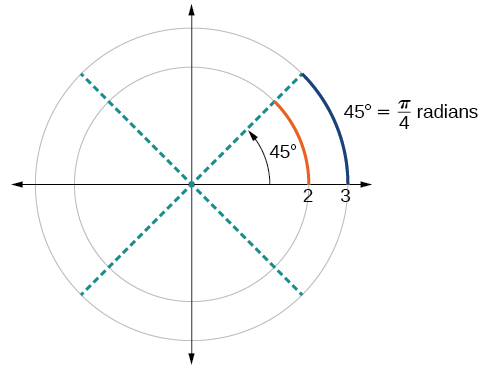
Notice what happens if we find the ratio of the arc length divided by the radius of the circle.
弧長を円の半径で割った比を求めると、何が起こるかに注目しよう。
Since both ratios are the angle measures of both circles are the same, even though the arc length and radius differ.
どちらの比も なので、弧長も半径も違うのに、二つの円の角の大きさは同じである。
Radians ラジアン
One radian is the measure of the central angle of a circle such that the length of the arc between the initial side and the terminal side is equal to the radius of the circle. A full revolution equals radians. A half revolution is equivalent to radians.
1ラジアンとは、始線と動径のあいだの弧の長さが円の半径に等しくなるような、円の中心角の大きさである。1回転 は ラジアンに等しい。半回転 は ラジアンに当たる。
The radian measure of an angle is the ratio of the length of the arc subtended by the angle to the radius of the circle. In other words, if is the length of an arc of a circle, and is the radius of the circle, then the central angle containing that arc measures radians. In a circle of radius 1, the radian measure corresponds to the length of the arc.
角のラジアンでの大きさとは、その角が張る弧の長さと円の半径の比である。言い換えれば、 が円の弧の長さ、 が円の半径なら、その弧を含む中心角の大きさは ラジアンである。半径1の円では、ラジアンでの大きさは弧の長さに対応する。
Q&A 疑問と答え
A measure of 1 radian looks to be about Is that correct?
1ラジアンの大きさは、およそ に見える。それは正しいか。
Yes. It is approximately Because radians equals radian equals
そうである。およそ である。 ラジアンが に等しいので、1ラジアンは に等しい。
Using Radiansラジアンを使う
Because radian measure is the ratio of two lengths, it is a unitless measure. For example, in Figure 12, suppose the radius were 2 inches and the distance along the arc were also 2 inches. When we calculate the radian measure of the angle, the “inches” cancel, and we have a result without units. Therefore, it is not necessary to write the label “radians” after a radian measure, and if we see an angle that is not labeled with “degrees” or the degree symbol, we can assume that it is a radian measure.
ラジアンでの大きさは二つの長さの比なので、単位を持たない量である。たとえば図12で、半径が2インチ、弧に沿った距離も2インチだとしよう。この角のラジアンでの大きさを計算すると「インチ」が消え、単位のない結果が得られる。したがって、ラジアンでの大きさの後に「ラジアン」という名札を書く必要は無く、「度」や度の記号が付いていない角を見たら、ラジアンでの大きさだと考えてよい。
Considering the most basic case, the unit circle (a circle with radius 1), we know that 1 rotation equals 360 degrees, We can also track one rotation around a circle by finding the circumference, and for the unit circle These two different ways to rotate around a circle give us a way to convert from degrees to radians.
最も基本の場合である単位円(半径1の円)を考えると、1回転が360度 に等しいと分かる。周 を求めても円の1回転を追える。単位円では である。円を1回転するこの二つの違うやり方が、度からラジアンに直す道を与えてくれる。
Identifying Special Angles Measured in Radiansラジアンで測った特別な角を見分ける
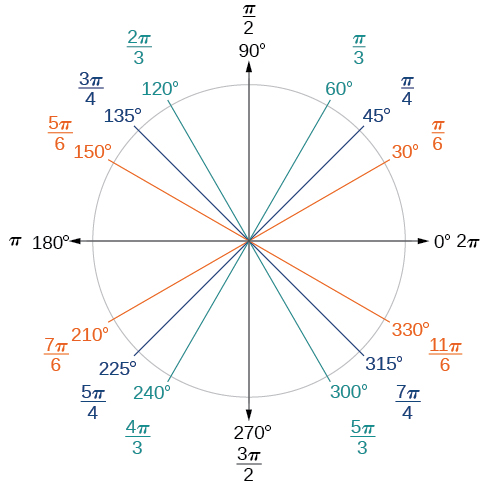
In addition to knowing the measurements in degrees and radians of a quarter revolution, a half revolution, and a full revolution, there are other frequently encountered angles in one revolution of a circle with which we should be familiar. It is common to encounter multiples of 30, 45, 60, and 90 degrees. These values are shown in Figure 14. Memorizing these angles will be very useful as we study the properties associated with angles.
4分の1回転、半回転、1回転の度とラジアンでの大きさを知っているのに加えて、円の1回転の中でよく出会う角がほかにもあり、それに慣れておくべきである。30、45、60、90度の倍数によく出会う。これらの値を図14に示す。これらの角を覚えておくと、角に関わる性質を学ぶときにとても役立つ。
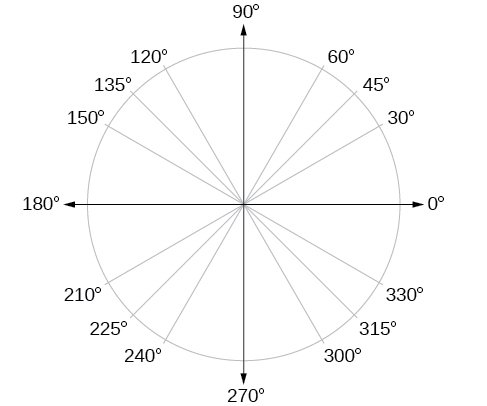
Now, we can list the corresponding radian values for the common measures of a circle corresponding to those listed in Figure 14, which are shown in Figure 15. Be sure you can verify each of these measures.
これで、図14に挙げたものに対応する円のよくある大きさについて、対応するラジアンの値を並べられる。図15に示す。それぞれの値を確かめられるようにしておこう。
Example 2例2
Finding a Radian Measureラジアンでの大きさを求める
Find the radian measure of one-third of a full rotation.
1回転の3分の1のラジアンでの大きさを求めよ。
Solution 解答
For any circle, the arc length along such a rotation would be one-third of the circumference. We know that
どの円でも、この回転に沿った弧長は周の3分の1になる。次が分かっている。
So,
よって、
The radian measure would be the arc length divided by the radius.
ラジアンでの大きさは、弧長を半径で割ったものである。
Try It #2やってみよう2
Find the radian measure of three-fourths of a full rotation.
1回転の4分の3のラジアンでの大きさを求めよ。
Converting Between Radians and Degreesラジアンと度を行き来する
Because degrees and radians both measure angles, we need to be able to convert between them. We can easily do so using a proportion where is the measure of the angle in degrees and is the measure of the angle in radians.
度もラジアンも角を測るものなので、この二つを行き来できる必要がある。 を度で表した角の大きさ、 をラジアンで表した角の大きさとして、比例式を使えば簡単に行き来できる。
This proportion shows that the measure of angle in degrees divided by 180 equals the measure of angle in radians divided by Or, phrased another way, degrees is to 180 as radians is to
この比例式は、度で表した角 の大きさを180で割ったものが、ラジアンで表した角 の大きさを で割ったものに等しいことを示している。別の言い方をすれば、度と180の比が、ラジアンと の比に等しいということである。
Converting between Radians and Degrees ラジアンと度の換算
To convert between degrees and radians, use the proportion
度とラジアンを相互に換算するには、次の比例式を使う。
Example 3例3
Converting Radians to Degreesラジアンを度に直す
Convert each radian measure to degrees.
次の各ラジアンでの大きさを度に直せ。
Solution 解答
Because we are given radians and we want degrees, we should set up a proportion and solve it.
ラジアンが与えられていて度がほしいので、比例式を立てて解けばよい。
ⓐWe use the proportion, substituting the given information. ⓑWe use the proportion, substituting the given information.
ⓐ与えられた情報を代入して、この比例式を使う。ⓑ与えられた情報を代入して、この比例式を使う。
Try It #3やってみよう3
Convert radians to degrees.
ラジアンを度に直せ。
Example 4例4
Converting Degrees to Radians度をラジアンに直す
Convert degrees to radians.
度をラジアンに直せ。
Solution 解答
In this example, we start with degrees and want radians, so we again set up a proportion, but we substitute the given information into a different part of the proportion.
この例では度から始めてラジアンがほしいので、ここでも比例式を立てるが、与えられた情報を比例式の違うところに代入する。
Analysis 考察
Another way to think about this problem is by remembering that Because we can find that is
この問題は、 であることを思い出しても考えられる。 なので、 が だと分かる。
Try It #4やってみよう4
Convert to radians.
をラジアンに直せ。
Finding Coterminal Angles動径が一致する角を求める
Converting between degrees and radians can make working with angles easier in some applications. For other applications, we may need another type of conversion. Negative angles and angles greater than a full revolution are more awkward to work with than those in the range of to or to It would be convenient to replace those out-of-range angles with a corresponding angle within the range of a single revolution.
度とラジアンを行き来できると、応用によっては角を扱うのが楽になる。ほかの応用では、別の種類の変換が要ることもある。負の角や1回転を超える角は、 から まで、あるいは から までの範囲の角より扱いにくい。この範囲の外の角を、1回転の範囲に収まる対応する角に置き換えられると都合がよい。
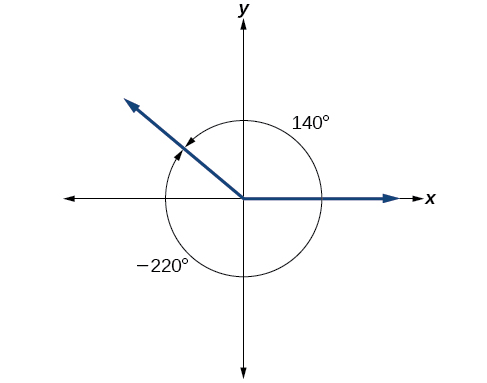
It is possible for more than one angle to have the same terminal side. Look at Figure 16. The angle of is a positive angle, measured counterclockwise. The angle of is a negative angle, measured clockwise. But both angles have the same terminal side. If two angles in standard position have the same terminal side, they are coterminal angles. Every angle greater than or less than is coterminal with an angle between and and it is often more convenient to find the coterminal angle within the range of to than to work with an angle that is outside that range.
二つ以上の角が同じ動径を持つことはありうる。図16を見よ。 の角は反時計回りに測った正の角である。 の角は時計回りに測った負の角である。だがどちらの角も動径は同じである。標準位置の二つの角の動径が同じなら、それを動径が一致する角という。 より大きい角、 より小さい角はどれも、 と のあいだのある角と動径が一致する。その範囲の外の角を扱うより、 から までの範囲で動径が一致する角を求めるほうが都合がよいことが多い。
Any angle has infinitely many coterminal angles because each time we add to that angle—or subtract from it—the resulting value has a terminal side in the same location. For example, and are coterminal for this reason, as is
どの角にも、動径が一致する角が無限にある。その角に を足すたび、あるいはそこから を引くたびに、できあがる値の動径が同じ場所にくるからである。たとえば と はこの理由で動径が一致し、 も同じである。
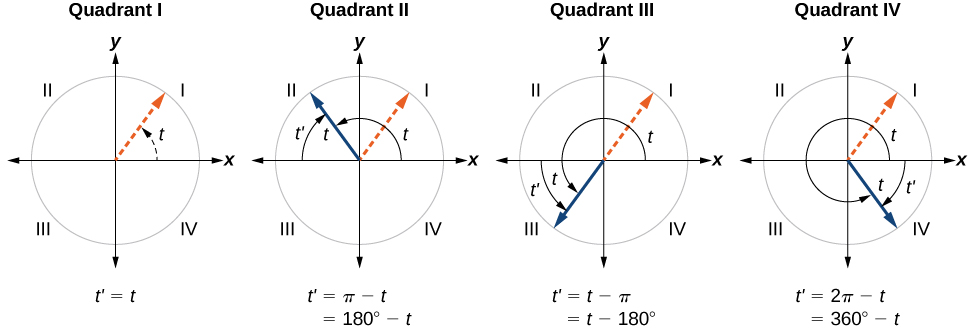
An angle’s reference angle is the measure of the smallest, positive, acute angle formed by the terminal side of the angle and the horizontal axis. Thus positive reference angles have terminal sides that lie in the first quadrant and can be used as models for angles in other quadrants. See Figure 17 for examples of reference angles for angles in different quadrants.
角の基準角とは、その角 の動径と横軸がなす、最も小さい正の鋭角 の大きさである。よって正の基準角の動径は第1象限にあり、ほかの象限の角のモデルとして使える。違う象限の角の基準角の例は図17を見よ。
Coterminal and Reference Angles 動径が一致する角と基準角
Coterminal angles are two angles in standard position that have the same terminal side.
動径が一致する角とは、標準位置にあって動径が同じである二つの角のことである。
An angle’s reference angle is the size of the smallest acute angle, formed by the terminal side of the angle and the horizontal axis.
角の基準角とは、その角 の動径と横軸がなす、最も小さい鋭角 の大きさである。
How To 手順
Given an angle greater than find a coterminal angle between and
より大きい角が与えられたとき、 と のあいだで動径が一致する角を求める。
1. Subtract from the given angle.2. If the result is still greater than subtract again till the result is between and 3. The resulting angle is coterminal with the original angle.
1. 与えられた角から を引く。2. 結果がまだ より大きいなら、結果が と のあいだに入るまで、もう一度 を引く。3. できあがった角が、元の角と動径が一致する角である。
Example 5例5
Finding an Angle Coterminal with an Angle of Measure Greater Than より大きい角と動径が一致する角を求める
Find the least positive angle that is coterminal with an angle measuring where
を満たし、大きさ の角と動径が一致する最小の正の角 を求めよ。
Solution 解答
An angle with measure is coterminal with an angle with measure but is still greater than so we subtract again to find another coterminal angle:
大きさ の角は大きさ の角と動径が一致するが、 はまだ より大きいので、もう一度 を引いて別の動径が一致する角を求める: 。
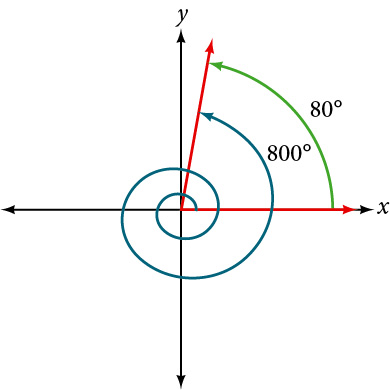
The angle is coterminal with To put it another way, equals plus two full rotations, as shown in Figure 18.
角 は と動径が一致する。別の言い方をすれば、図18に示すとおり、 は に2回転を足したものに等しい。
Try It #5やってみよう5
Find an angle that is coterminal with an angle measuring where
を満たし、大きさ の角と動径が一致する角 を求めよ。
How To 手順
Given an angle with measure less than find a coterminal angle having a measure between and
大きさが より小さい角が与えられたとき、 と のあいだの大きさで動径が一致する角を求める。
1. Add to the given angle.2. If the result is still less than add again until the result is between and 3. The resulting angle is coterminal with the original angle.
1. 与えられた角に を足す。2. 結果がまだ より小さいなら、結果が と のあいだに入るまで、もう一度 を足す。3. できあがった角が、元の角と動径が一致する角である。
Example 6例6
Finding an Angle Coterminal with an Angle Measuring Less Than より小さい角と動径が一致する角を求める
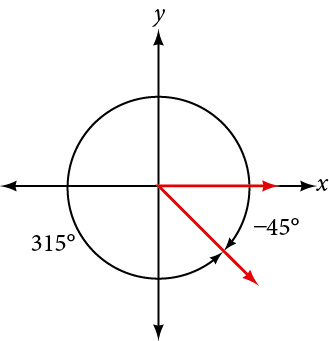
Show the angle with measure on a circle and find a positive coterminal angle such that
大きさ の角を円の上に示し、 を満たす、動径が一致する正の角 を求めよ。
Solution 解答
Since is half of we can start at the positive horizontal axis and measure clockwise half of a angle.
は の半分なので、正の横軸から始めて、時計回りに の角の半分を測ればよい。
Because we can find coterminal angles by adding or subtracting a full rotation of we can find a positive coterminal angle here by adding
1回転の を足したり引いたりすれば動径が一致する角が求まるので、ここでは を足して動径が一致する正の角を求められる。
We can then show the angle on a circle, as in Figure 19.
そして図19のように、この角を円の上に示せる。
Try It #6やってみよう6
Find an angle that is coterminal with an angle measuring such that
を満たし、大きさ の角と動径が一致する角 を求めよ。
Finding Coterminal Angles Measured in Radiansラジアンで測った、動径が一致する角を求める
We can find coterminal angles measured in radians in much the same way as we have found them using degrees. In both cases, we find coterminal angles by adding or subtracting one or more full rotations.
ラジアンで測った、動径が一致する角も、度を使ったのとほぼ同じやり方で求められる。どちらの場合も、1回転かそれ以上を足したり引いたりして、動径が一致する角を求める。
How To 手順
Given an angle greater than find a coterminal angle between 0 and
より大きい角が与えられたとき、0と のあいだで動径が一致する角を求める。
1. Subtract from the given angle.2. If the result is still greater than subtract again until the result is between and 3. The resulting angle is coterminal with the original angle.
1. 与えられた角から を引く。2. 結果がまだ より大きいなら、結果が と のあいだに入るまで、もう一度 を引く。3. できあがった角が、元の角と動径が一致する角である。
Example 7例7
Finding Coterminal Angles Using Radiansラジアンを使って、動径が一致する角を求める
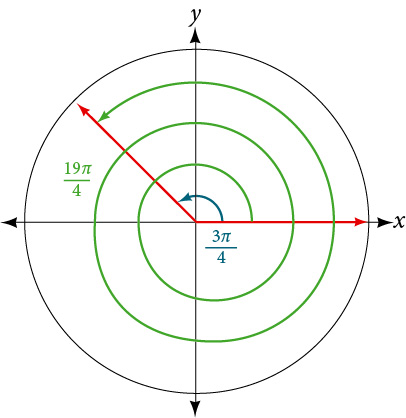
Find an angle that is coterminal with where
を満たし、 と動径が一致する角 を求めよ。
Solution 解答
When working in degrees, we found coterminal angles by adding or subtracting 360 degrees, a full rotation. Likewise, in radians, we can find coterminal angles by adding or subtracting full rotations of radians:
度で扱うときは、1回転の360度を足したり引いたりして動径が一致する角を求めた。同じく、ラジアンでも1回転の ラジアンを足したり引いたりして動径が一致する角を求められる。
The angle is coterminal, but not less than so we subtract another rotation.
角 は動径が一致するが より小さくないので、もう1回転分を引く。
The angle is coterminal with as shown in Figure 20.
図20に示すとおり、角 は と動径が一致する。
Try It #7やってみよう7
Find an angle of measure that is coterminal with an angle of measure where
を満たし、大きさ の角と動径が一致する大きさ の角を求めよ。
Determining the Length of an Arc弧の長さを決める
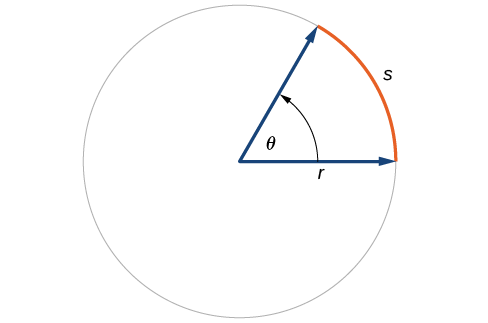
Recall that the radian measure of an angle was defined as the ratio of the arc length of a circular arc to the radius of the circle, From this relationship, we can find arc length along a circle, given an angle.
角のラジアンでの大きさ が、円弧の弧長 と円の半径 の比 として定められたことを思い出そう。この関係から、角が与えられれば円に沿った弧長が求められる。
Arc Length on a Circle 円弧の長さ
In a circle of radius r, the length of an arc subtended by an angle with measure in radians, shown in Figure 21, is
半径 r の円で、ラジアンで大きさ の角が張る弧の長さ は、図21に示すとおり次のとおりである。
How To 手順
Given a circle of radius calculate the length of the arc subtended by a given angle of measure
半径 の円が与えられたとき、大きさ の角が張る弧の長さ を計算する。
1. If necessary, convert to radians.2. Multiply the radius
1. 必要なら をラジアンに直す。2. 半径 を掛ける。
Example 8例8
Finding the Length of an Arc弧の長さを求める
Assume the orbit of Mercury around the sun is a perfect circle. Mercury is approximately 36 million miles from the sun.
水星の太陽のまわりの軌道を完全な円だとする。水星は太陽からおよそ3600万マイル離れている。
ⓐIn one Earth day, Mercury completes 0.0114 of its total revolution. How many miles does it travel in one day?ⓑUse your answer from part (a) to determine the radian measure for Mercury’s movement in one Earth day.
ⓐ地球の1日で、水星は公転の全体の0.0114だけ進む。1日に何マイル進むか。ⓑ(a)の答えを使って、地球の1日での水星の動きのラジアンでの大きさを決めよ。
Solution 解答
ⓐLet’s begin by finding the circumference of Mercury’s orbit. Since Mercury completes 0.0114 of its total revolution in one Earth day, we can now find the distance traveled. ⓑNow, we convert to radians.
ⓐまず水星の軌道の周を求めよう。。水星は地球の1日で公転の全体の0.0114だけ進むので、進む距離が求められる。。ⓑ次にラジアンに直す。
Try It #8やってみよう8
Find the arc length along a circle of radius 10 units subtended by an angle of
半径10単位の円で、 の角が張る弧長を求めよ。
Finding the Area of a Sector of a Circle円の扇形の面積を求める
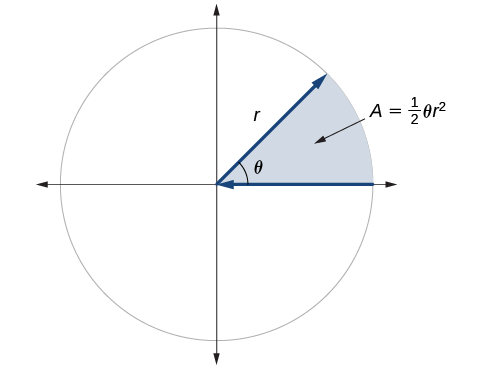
In addition to arc length, we can also use angles to find the area of a sector of a circle. A sector is a region of a circle bounded by two radii and the intercepted arc, like a slice of pizza or pie. Recall that the area of a circle with radius can be found using the formula If the two radii form an angle of measured in radians, then is the ratio of the angle measure to the measure of a full rotation and is also, therefore, the ratio of the area of the sector to the area of the circle. Thus, the area of a sector is the fraction multiplied by the entire area. (Always remember that this formula only applies if is in radians.)
弧長に加えて、角を使えば円の扇形の面積も求められる。扇形とは、ピザやパイの一切れのように、二本の半径と切りとられた弧で囲まれた円の一部である。半径 の円の面積が公式 で求まることを思い出そう。二本の半径がラジアンで測って の角をなすなら、 は角の大きさと1回転の大きさの比であり、したがって扇形の面積と円の面積の比でもある。よって扇形の面積は、全体の面積に分数 を掛けたものである。(この公式は がラジアンのときだけ当てはまることをつねに忘れないでほしい。)
Area of a Sector 扇形の面積
The area of a sector of a circle with radius subtended by an angle measured in radians, is
半径 の円で、ラジアンで測った角 が張る扇形の面積は、次のとおりである。
See Figure 22.
図22を見よ。
How To 手順
Given a circle of radius find the area of a sector defined by a given angle
半径 の円が与えられたとき、与えられた角 が定める扇形の面積を求める。
1. If necessary, convert to radians.2. Multiply half the radian measure of by the square of the radius
1. 必要なら をラジアンに直す。2. のラジアンでの大きさの半分に、半径 の2乗を掛ける。
Example 9例9
Finding the Area of a Sector扇形の面積を求める
An automatic lawn sprinkler sprays a distance of 20 feet while rotating 30 degrees, as shown in Figure 23. What is the area of the sector of grass the sprinkler waters?
図23に示すとおり、自動の芝生用散水機が30度回りながら20フィートの距離まで水をまく。散水機が水をまく芝生の扇形の面積はいくらか。

Solution 解答
First, we need to convert the angle measure into radians. Because 30 degrees is one of our special angles, we already know the equivalent radian measure, but we can also convert:
まず、角の大きさをラジアンに直す必要がある。30度は特別な角の一つなので、対応するラジアンでの大きさはすでに分かっているが、直してみることもできる。
The area of the sector is then
すると扇形の面積は次のとおりである。
So the area is about
よって面積はおよそ である。
Try It #9やってみよう9
In central pivot irrigation, which creates the field shapes similar to the image at the beginning of Equations and Inequalities, a large irrigation pipe on wheels rotates around a center point. A farmer has a central pivot system with a radius of 400 meters. If water restrictions only allow her to water 150 thousand square meters a day, what angle should she set the system to cover? Write the answer in radian measure to two decimal places.
「方程式と不等式」の初めの図に似た畑の形を作るセンターピボット灌漑では、車輪の付いた大きな灌漑用の管が中心の点のまわりを回る。ある農家が半径400メートルのセンターピボットの設備を持っている。水の制限のため1日に15万平方メートルにしか水をまけないなら、この設備を何度の角に合わせればよいか。答えはラジアンで小数第二位まで書け。
Use Linear and Angular Speed to Describe Motion on a Circular Path円運動を線速度と角速度で表す
In addition to finding the area of a sector, we can use angles to describe the speed of a moving object. An object traveling in a circular path has two types of speed. Linear speed is speed along a straight path and can be determined by the distance it moves along (its displacement) in a given time interval. For instance, if a wheel with radius 5 inches rotates once a second, a point on the edge of the wheel moves a distance equal to the circumference, or inches, every second. So the linear speed of the point is in./s. The equation for linear speed is as follows where is linear speed, is displacement, and is time.
扇形の面積を求めるのに加えて、角を使えば動く物の速さも述べられる。円の道筋を進む物には、二つの種類の速さがある。線速度とはまっすぐな道筋に沿った速さで、与えられた時間の間隔にその物が動く距離(その変位)で決められる。たとえば半径5インチの車輪が1秒に1回転するなら、車輪の縁の点は毎秒、周に等しい距離、すなわち インチ動く。よってこの点の線速度は毎秒 インチである。線速度の式は次のとおりである。ここで は線速度、 は変位、 は時間である。
Angular speed results from circular motion and can be determined by the angle through which a point rotates in a given time interval. In other words, angular speed is angular rotation per unit time. So, for instance, if a gear makes a full rotation every 4 seconds, we can calculate its angular speed as 90 degrees per second. Angular speed can be given in radians per second, rotations per minute, or degrees per hour for example. The equation for angular speed is as follows, where (read as omega) is angular speed, is the angle traversed, and is time.
角速度は円運動から生じ、与えられた時間の間隔に点が回る角で決められる。言い換えれば、角速度とは単位時間あたりの角の回転である。たとえば、ある歯車が4秒ごとに1回転するなら、その角速度は 、すなわち毎秒90度と計算できる。角速度は、たとえば毎秒ラジアン、毎分回転数、毎時度などで表せる。角速度の式は次のとおりである。ここで (オメガと読む)は角速度、 は通った角、 は時間である。
Combining the definition of angular speed with the arc length equation, we can find a relationship between angular and linear speeds. The angular speed equation can be solved for giving Substituting this into the arc length equation gives:
角速度の定義を弧長の式 と合わせれば、角速度と線速度の関係が求められる。角速度の式を について解くと が得られる。これを弧長の式に代入すると、次が得られる。
Substituting this into the linear speed equation gives:
これを線速度の式に代入すると、次が得られる。
Angular and Linear Speed 角速度と線速度
As a point moves along a circle of radius its angular speed, is the angular rotation per unit time,
点が半径 の円に沿って動くとき、その角速度 は、単位時間 あたりの角の回転 である。
The linear speed, of the point can be found as the distance traveled, arc length per unit time,
この点の線速度 は、進んだ距離すなわち弧長 を単位時間 で割ったものとして求められる。
When the angular speed is measured in radians per unit time, linear speed and angular speed are related by the equation
角速度を単位時間あたりのラジアンで測るとき、線速度と角速度は次の式で結ばれる。
This equation states that the angular speed in radians, representing the amount of rotation occurring in a unit of time, can be multiplied by the radius to calculate the total arc length traveled in a unit of time, which is the definition of linear speed.
この式は、単位時間に起こる回転の量を表すラジアンでの角速度 に半径 を掛ければ、単位時間に進む弧長の全体、すなわち線速度の定義そのものが計算できることを述べている。
How To 手順
Given the amount of angle rotation and the time elapsed, calculate the angular speed.
角の回転の量と経った時間が与えられたとき、角速度を計算する。
1. If necessary, convert the angle measure to radians.2. Divide the angle in radians by the number of time units elapsed: 3. The resulting speed will be in radians per time unit.
1. 必要なら、角の大きさをラジアンに直す。2. ラジアンでの角を、経った時間の単位の数で割る: 。3. できあがる速さは、単位時間あたりのラジアンになる。
Water wheels have been used for thousands of years to transfer the power of flowing water to other devices. The image below depicts the design of the the 3rd century Roman water wheel in Hierapolis, a city in what is now Turkey. Water turned the wheel, which in turn rotated a crank connected to two saws used to cut blocks. These design elements were used in water wheel applications throughout the world, and even provided the underlying principle for the steam engine, invented about 1500 years later.
水車は、流れる水の力をほかの装置へ伝えるために何千年も使われてきた。下の図は、今のトルコにあたる地域の都市ヒエラポリスの、3世紀のローマの水車の造りを描いたものである。水が車輪を回し、その車輪が、石材を切る二つの鋸につながった曲柄を回した。この造りの要素は世界中の水車の応用に使われ、およそ1500年後に発明された蒸気機関の基となる原理さえもたらした。
Example 10例10
Finding Angular Speed角速度を求める
A water wheel, shown in Figure 24, completes 1 rotation every 5 seconds. Find the angular speed in radians per second.
図24に示す水車が、5秒ごとに1回転する。毎秒ラジアンでの角速度を求めよ。
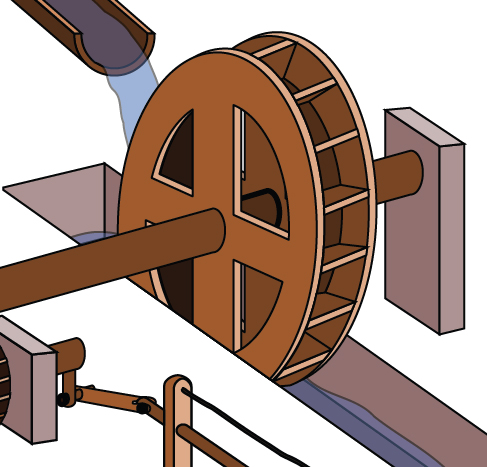
Solution 解答
The wheel completes 1 rotation, or passes through an angle of radians in 5 seconds, so the angular speed would be radians per second.
この車輪は5秒で1回転、すなわち ラジアンの角を通るので、角速度は毎秒 ラジアンになる。
Try It #10やってみよう10
A vintage vinyl record is played on a turntable rotating clockwise at a rate of 45 rotations per minute. Find the angular speed in radians per second.
古いレコードを、毎分45回転で時計回りに回る回転盤でかける。毎秒ラジアンでの角速度を求めよ。
How To 手順
Given the radius of a circle, an angle of rotation, and a length of elapsed time, determine the linear speed.
円の半径、回転の角、経った時間の長さが与えられたとき、線速度を決める。
1. Convert the total rotation to radians if necessary.2. Divide the total rotation in radians by the elapsed time to find the angular speed: apply 3. Multiply the angular speed by the length of the radius to find the linear speed, expressed in terms of the length unit used for the radius and the time unit used for the elapsed time: apply
1. 必要なら、回転の全体をラジアンに直す。2. ラジアンでの回転の全体を経った時間で割って、角速度を求める: を当てはめる。3. 角速度に半径の長さを掛けて線速度を求める。半径に使った長さの単位と、経った時間に使った時間の単位で表される: を当てはめる。
Example 11例11
Finding a Linear Speed線速度を求める
A bicycle has wheels 28 inches in diameter. A tachometer determines the wheels are rotating at 180 RPM (revolutions per minute). Find the speed the bicycle is traveling down the road.
ある自転車の車輪の直径は28インチである。回転計で、車輪が毎分180回転(RPM)で回っていると分かる。この自転車が道を進む速さを求めよ。
Solution 解答
Here, we have an angular speed and need to find the corresponding linear speed, since the linear speed of the outside of the tires is the speed at which the bicycle travels down the road.
ここでは角速度があり、対応する線速度を求める必要がある。タイヤの外側の線速度が、自転車が道を進む速さだからである。
We begin by converting from rotations per minute to radians per minute. It can be helpful to utilize the units to make this conversion:
まず毎分回転数から毎分ラジアンに直す。この変換には単位を使うと役立つ。
Using the formula from above along with the radius of the wheels, we can find the linear speed:
上の公式と車輪の半径を使えば、線速度が求められる。
Remember that radians are a unitless measure, so it is not necessary to include them.
ラジアンは単位を持たない量なので、書き入れる必要は無いことを忘れないでほしい。
Finally, we may wish to convert this linear speed into a more familiar measurement, like miles per hour.
最後に、この線速度を毎時マイルのような、もっとなじみのある測り方に直したくなるだろう。
Try It #11やってみよう11
A satellite is rotating around Earth at 0.25 radian per hour at an altitude of 242 km above Earth. If the radius of Earth is 6378 kilometers, find the linear speed of the satellite in kilometers per hour.
ある人工衛星が、地表から高度242kmのところを毎時0.25ラジアンで地球のまわりを回っている。地球の半径を6378キロメートルとして、この人工衛星の毎時キロメートルでの線速度を求めよ。
Media 教材
Access these online resources for additional instruction and practice with angles, arc length, and areas of sectors.
角、弧長、扇形の面積についての説明と練習をさらに求めるなら、次のオンライン教材にあたるとよい。
• Angles in Standard Position• Angle of Rotation• Coterminal Angles• Determining Coterminal Angles• Positive and Negative Coterminal Angles• Radian Measure• Coterminal Angles in Radians• Arc Length and Area of a Sector
・標準位置の角・回転の角・動径が一致する角・動径が一致する角を決める・動径が一致する正と負の角・ラジアンでの大きさ・ラジアンでの、動径が一致する角・弧長と扇形の面積
Verbal言葉で答える問題
2. Explain why there are an infinite number of angles that are coterminal to a certain angle.
2. ある角と動径が一致する角が無限にあるのはなぜかを説明せよ。
4. How does radian measure of an angle compare to the degree measure? Include an explanation of 1 radian in your paragraph.
4. 角のラジアンでの大きさは、度での大きさとどう比べられるか。1ラジアンの説明を文中に入れよ。
Graphicalグラフの問題
For the following exercises, draw an angle in standard position with the given measure.
次の各問について、与えられた大きさの角を標準位置に描け。
For the following exercises, draw an angle in standard position with the given measure as well as a coterminal angle.
次の各問について、与えられた大きさの角と、それと動径が一致する角を標準位置に描け。
For the following exercises, refer to Figure 25. Round to two decimal places.
次の各問では、図25を参照せよ。小数第二位まで丸めよ。
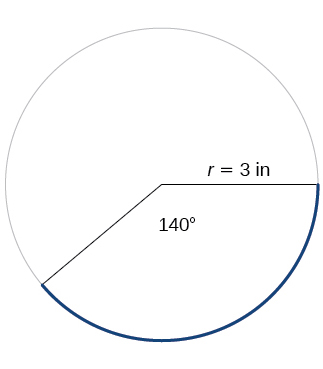
22. Find the arc length.
22. 弧長を求めよ。
For the following exercises, refer to Figure 26. Round to two decimal places.
次の各問では、図26を参照せよ。小数第二位まで丸めよ。
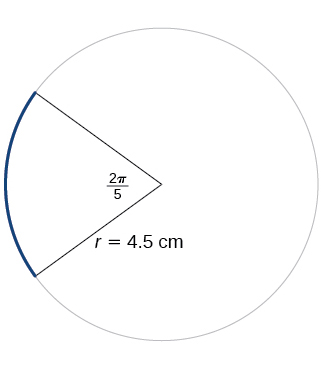
24. Find the arc length.
24. 弧長を求めよ。
Algebraic代数の問題
For the following exercises, convert angles in radians to degrees.
次の各問について、ラジアンでの角を度に直せ。
26. radians
26. ラジアン
28. radians
28. ラジアン
30. radians
30. ラジアン
32. radians
32. ラジアン
For the following exercises, convert angles in degrees to radians.
次の各問について、度での角をラジアンに直せ。
For the following exercises, use the given information to find the length of a circular arc. Round to two decimal places.
次の各問について、与えられた情報を使って円弧の長さを求めよ。小数第二位まで丸めよ。
40. Find the length of the arc of a circle of radius 12 inches subtended by a central angle of radians.
40. 半径12インチの円で、中心角 ラジアンが張る弧の長さを求めよ。
42. Find the length of the arc of a circle of diameter 14 meters subtended by the central angle of
42. 直径14メートルの円で、中心角 が張る弧の長さを求めよ。
44. Find the length of the arc of a circle of radius 5 inches subtended by the central angle of
44. 半径5インチの円で、中心角 が張る弧の長さを求めよ。
For the following exercises, use the given information to find the area of the sector. Round to four decimal places.
次の各問について、与えられた情報を使って扇形の面積を求めよ。小数第四位まで丸めよ。
46. A sector of a circle has a central angle of and a radius 6 cm.
46. ある円の扇形の中心角は 、半径は6cmである。
48. A sector of a circle with diameter 10 feet and an angle of radians.
48. 直径10フィートの円の、角 ラジアンの扇形。
For the following exercises, find the angle between and that is coterminal to the given angle.
次の各問について、与えられた角と動径が一致する、 と のあいだの角を求めよ。
For the following exercises, find the angle between 0 and in radians that is coterminal to the given angle.
次の各問について、与えられた角と動径が一致する、0と のあいだのラジアンでの角を求めよ。
Real-World Applications応用問題
58. A truck with 32-inch diameter wheels is traveling at 60 mi/h. Find the angular speed of the wheels in rad/min. How many revolutions per minute do the wheels make?
58. 直径32インチの車輪のトラックが、毎時60マイルで走っている。車輪の角速度を毎分ラジアンで求めよ。車輪は毎分何回転するか。
60. A wheel of radius 8 inches is rotating 15°/s. What is the linear speed the angular speed in RPM, and the angular speed in rad/s?
60. 半径8インチの車輪が毎秒15°で回っている。線速度 、RPM での角速度、毎秒ラジアンでの角速度はいくらか。
62. A computer hard drive disc has diameter of 120 millimeters. When playing audio, the angular speed varies to keep the linear speed constant where the disc is being read. When reading along the outer edge of the disc, the angular speed is about 200 RPM (revolutions per minute). Find the linear speed.
62. あるコンピュータのハードディスクの直径は120ミリメートルである。音声を再生するとき、読みとっている場所の線速度を一定に保つために角速度が変わる。ディスクの外縁に沿って読みとるとき、角速度はおよそ毎分200回転(RPM)である。線速度を求めよ。
63. When being burned in a writable CD-R drive, the angular speed of a CD is often much faster than when playing audio, but the angular speed still varies to keep the linear speed constant where the disc is being written. When writing along the outer edge of the disc, the angular speed of one drive is about 4800 RPM (revolutions per minute). Find the linear speed if the CD has diameter of 120 millimeters.
63. 書き込み可能な CD-R ドライブで焼くとき、CD の角速度は音声を再生するときよりずっと速いことが多いが、書き込んでいる場所の線速度を一定に保つために角速度はやはり変わる。ディスクの外縁に沿って書き込むとき、あるドライブの角速度はおよそ毎分4800回転(RPM)である。CD の直径が120ミリメートルのとき、線速度を求めよ。
64. A person is standing on the equator of Earth (radius 3960 miles). What are their linear and angular speeds?
64. ある人が地球の赤道(半径3960マイル)の上に立っている。その人の線速度と角速度はいくらか。
66. Find the distance along an arc on the surface of Earth that subtends a central angle of 7 minutes
. The radius of Earth is miles.
66. 地球の表面で、中心角7分 が張る弧に沿った距離を求めよ。地球の半径は マイルである。
Extensions発展問題
68. Two cities have the same longitude. The latitude of city A is 9 degrees north and the latitude of city B is 30 degrees north. Assume the radius of the earth is 3960 miles. Find the distance between the two cities.
68. 二つの都市の経度が同じである。都市Aの緯度は北緯9度、都市Bの緯度は北緯30度である。地球の半径を3960マイルとする。この二つの都市のあいだの距離を求めよ。
70. A city is located at 75 degrees north latitude. Assume the radius of the earth is 3960 miles and the earth rotates once every 24 hours. Find the linear speed of a person who resides in this city.
70. ある都市は北緯75度にある。地球の半径を3960マイル、地球は24時間で1回転するとする。この都市に住む人の線速度を求めよ。
72. A bicycle has wheels 28 inches in diameter. A tachometer determines that the wheels are rotating at 180 RPM (revolutions per minute). Find the speed the bicycle is travelling down the road.
72. ある自転車の車輪の直径は28インチである。回転計で、車輪が毎分180回転(RPM)で回っていると分かる。この自転車が道を進む速さを求めよ。
74. A wheel on a tractor has a 24-inch diameter. How many revolutions does the wheel make if the tractor travels 4 miles?
74. あるトラクターの車輪の直径は24インチである。このトラクターが4マイル走ると、車輪は何回転するか。