第1章コンピューターサイエンス入門
Designing Technologies for Social Good社会に役立つ技術の設計
Computer science can advance social good by benefiting many people in many different areas, including public health, agricultural sustainability, climate sustainability, and education.
コンピューターサイエンスは、公衆衛生、農業の持続可能性、気候の持続可能性、教育など、多くの領域で多くの人々に利益をもたらすことで、社会のよい状態を前進させられる。
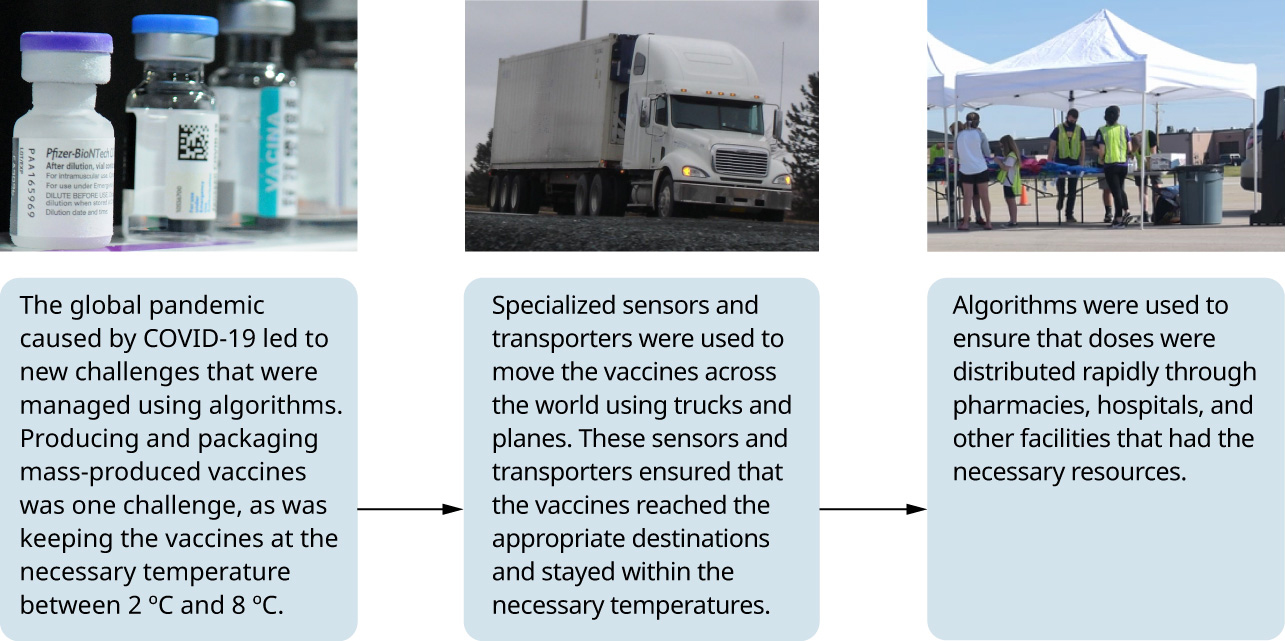
Computer technologies accelerate medical treatments for public and personal health from initial research and development to clinical trials to large-scale production and distribution. In January 2020, Chinese officials posted the genetic sequence of the coronavirus SARS-CoV-2. This helped pharmaceutical companies to begin developing potential vaccines for the virus at a significantly faster rate than for any other virus in the past (Figure 1.11).
英語のヒント
コンピューター技術は、集団と個人の健康のための医療を、初期の研究開発から臨床試験、大規模な生産・流通に至るまで加速する。2020年1月、中国当局はコロナウイルスSARS-CoV-2の遺伝子配列を公表した。これにより製薬企業は、過去の他のどのウイルスの場合よりも著しく速いペースで、ワクチン候補の開発を始めることができた(図1.11)。
credit left: modification of "COVID-19 vaccines" by Agência Brasília/Flickr, CC BY 2.0; credit center: modification of "T04" by Sarah Taylor/Flickr, CC BY 2.0; credit right: modification of “Back2School Brigade prepares families for upcoming school year” by Thomas Karol/DVIDS, Public Domain · CC BY 2.0 / Public Domain · Source出典
Figure 1.11 The SARS-CoV-2 outbreak that began in 2020 displayed how quickly computer science could be harnessed by governments, medical facilities, and scientists to decode the virus, develop treatments, and distribute vaccinations around the world. What would have been a very difficult feat to manage manually was simplified through the use of algorithms and computer technology. (credit left: modification of "COVID-19 vaccines" by Agência Brasília/Flickr, CC BY 2.0; credit center: modification of "T04" by Sarah Taylor/Flickr, CC BY 2.0; credit right: modification of “Back2School Brigade prepares families for upcoming school year” by Thomas Karol/DVIDS, Public Domain)
英語のヒント
図1.11 2020年に始まったSARS-CoV-2の流行は、政府、医療施設、科学者が、ウイルスの解読、治療法の開発、世界中へのワクチン提供に向けて、どれほど速くコンピューターサイエンスを活用できるかを示した。手作業なら非常に困難だったはずの仕事が、アルゴリズムとコンピューター技術によって簡単になった。(出典左:Agência Brasília/Flickr「COVID-19 vaccines」を改変、CC BY 2.0。中央:Sarah Taylor/Flickr「T04」を改変、CC BY 2.0。右:Thomas Karol/DVIDS「Back2School Brigade prepares families for upcoming school year」を改変、パブリックドメイン)
Computational science enables the miracles of modern medicine. Viral sequences can be digitized and rapidly shared between researchers across the world via the Internet. Computer algorithms and models can simulate the human immune system responses to particular treatments within hours rather than years. The first treatments can then be produced at a small scale using computer-engineered cells in less than a month from the initial sequencing. To ensure the treatments are safe and effective, clinical trials are held at disease transmission “hot spots” predicted using data science methods drawing on data aggregated and monitored from across the world. Once a treatment is proven safe and effective, it is mass-produced with the help of computer-controlled robots and automated assembly lines. Algorithms manage the inventory supply and demand and control the transportation of treatments on trucks and planes guided by computer navigation systems. Web apps and services notify people throughout the process.
英語のヒント
計算科学は、現代医療の驚くべき成果を可能にする。ウイルスの配列はデジタル化され、インターネットで世界中の研究者に素早く共有できる。アルゴリズムとモデルは、特定の治療に対する人間の免疫系の反応を、何年もかけず、数時間でシミュレーションできる。その後、コンピューターで設計した細胞を使い、最初の配列決定から1か月以内に、小規模な初期の治療薬の生産が可能になる。安全性と有効性を確かめる臨床試験は、世界中から集めて監視したデータを利用するデータサイエンスによって、病気の伝播の「ホットスポット」と予測された場所で行われる。治療法が安全で有効だと確認されると、コンピューター制御のロボットや自動組立ラインの助けで大量生産される。アルゴリズムは在庫の供給と需要を管理し、コンピューターのナビゲーションシステムに導かれたトラックや航空機による輸送を制御する。Webアプリやサービスは、その過程を通じて人々に通知を送る。
Yet the use of computer technology throughout modern medicine is anything but politically neutral. Computers, algorithms, and mathematical models solve the problems that their creators wish to solve and encode the assumptions of their target populations. Supply and demand data for the data models are determined by various factors, at least partly in response to the money and relationships between countries that control the technology, the Global North, and countries that don’t, the Global South. Within local communities, the uptake of medical treatments is often inequitable, reflecting and reinforcing historical inequities and disparities in public health. Computer technology alone often doesn’t address these issues. In fact, without people thinking about these issues, computer technologies can often amplify disparities. Consider datasets, which can be biased if they overrepresent or underrepresent specific groups of people. If decisions are made on the basis of biased data, people in the groups that are not represented fairly may receive inequitable treatment. For example, if a local government agency is working with a biased dataset, political leaders may make decisions that result in certain citizens receiving inadequate funding or services. This is an example of why responsible computing, which we will cover in Chapter 14 Cyber Resources Qualities and Cyber Computing Governance, is so important.
英語のヒント
しかし、現代医療のあらゆる過程で使われるコンピューター技術は、政治的に中立とは到底いえない。コンピューター、アルゴリズム、数学モデルは、作り手が解きたいと望む問題を解き、対象とする集団についての前提を組み込む。データモデルの供給・需要のデータは、さまざまな要因によって決まる。その少なくとも一部は、技術を支配するグローバルノースの国々と、支配できないグローバルサウスの国々の間のお金や関係に左右される。地域共同体の中でも、治療を受けられる状況はしばしば不平等で、公衆衛生における歴史的な不平等や格差を反映し、強めている。コンピューター技術だけでこうした問題が解決することは少ない。実際、人々がこれらの問題について考えなければ、技術は格差を拡大しうる。データ集合を考えてみよう。特定の集団が過大または過少に含まれていれば、データは偏る。そのデータに基づいて判断すれば、公正に表されていない集団の人々が、不公正な扱いを受けることがある。例えば地方自治体の機関が偏ったデータ集合を使っていれば、政治指導者の判断によって、一部の住民に十分な資金やサービスが届かなくなるかもしれない。これは、第14章「サイバー資源の品質とサイバーコンピューティングのガバナンス」で扱う、責任あるコンピューティングが極めて重要である理由の一例である。
These problematic histories are not only aggravated in medicine and public health, but also reflected in housing. Redlining refers to the inequitable access to basic public services based on residents’ neighborhoods and communities, which includes the practice of withholding financial services from areas with a large underrepresented population. In the United States, these communities reflect the histories of racial segregation and racial wealth inequalities. Fair housing laws are intended to prevent property owners from discriminating against buyers or renters because of race, color, ability, national origin, and other protected classes. But computer technologies also present new kinds of challenges. Microtargeted ads on social media platforms contribute to not only political polarization, but also discrimination in housing. This can be a particular problem when combined with redlining. Even if the ad targeting is not explicitly designed to discriminate, microtargeted ads can still reinforce historical redlining by incorporating data such as zip codes or neighborhoods. This may result in digital redlining, which is the practice of using technology, such as targeted ads, to promote discrimination. In 2021, a Facebook user filed a class-action lawsuit that argued nine companies in the Washington, D.C., area deliberately excluded people over the age of 50 from seeing their advertisements for housing because they wanted to attract younger people to live in their apartments.16 This is an example of an issue in technology that should be addressed by responsible computing with an emphasis on ethical behavior.
英語のヒント
こうした問題のある歴史は、医療や公衆衛生で悪化するだけでなく、住宅にも表れている。レッドライニングとは、住む地区や共同体を理由として、基本的な公共サービスへのアクセスが不平等になることを指す。十分に代表されていない人々が多く住む地域から、金融サービスを引き上げる慣行も含まれる。アメリカでは、こうした地域には人種隔離や、人種間の資産格差の歴史が反映されている。公正な住宅取引に関する法律は、不動産所有者が、購入者や借り手を、人種、肌の色、能力、出身国など、法的に保護される属性を理由に差別することを防ぐためにある。しかし、コンピューター技術は新しい種類の課題も生み出す。ソーシャルメディア上の細かく対象を絞る広告は、政治的な分極化だけでなく、住宅差別にもつながる。これは、レッドライニングと組み合わさると特に問題になる。広告の対象選定が明示的には差別を目的としていなくても、郵便番号や居住地区などのデータを取り入れることで、歴史的なレッドライニングを強化しうる。こうして、ターゲティング広告などの技術を利用して差別を促す「デジタル・レッドライニング」が起こる場合がある。2021年、あるFacebook利用者は、ワシントンD.C.周辺の九つの企業に対し、若者を集合住宅へ入居させたいという理由で、50歳を超える人々に住宅広告が表示されないよう意図的に排除したと主張して、集団訴訟を起こした。16 これは、倫理的な行動を重視する、責任あるコンピューティングによって対処すべき技術上の問題の例である。
With good intentions and attention to personal biases, technologies can be designed for social good. For example, a hypothetical algorithm for fair housing could evenly distribute new housing to people across protected classes and marginalized identities, such as older populations. Of course, algorithmic control and automated decision-making is challenged to consider the underlying conditions behind social problems. Still, algorithms can be important tools to enable us to distribute outcomes more fairly from a statistical perspective, and this can be an important step in addressing the larger societal systems and inequities that produce social problems.
英語のヒント
善意を持ち、自分自身の偏りに注意を払えば、技術は社会に役立つように設計できる。例えば、公正な住宅供給のための仮想的なアルゴリズムなら、法的に保護される属性の人々や、高齢者など周辺化されがちな人々に、新しい住宅を均等に配分することもできるだろう。もっとも、アルゴリズムによる制御や自動的な意思決定には、社会問題の背後にある根本的な条件まで考慮する難しさがある。それでもアルゴリズムは、統計的な観点から結果をより公正に配分するための重要な道具となりうる。それは、社会問題を生み出す、より大きな社会の仕組みや不平等に対処するための、重要な一歩になりうる。