第1章コンピューターサイエンス入門
The Capabilities and Limitations of Computer Scienceコンピューターサイエンスにできることと、その限界
Computers can be understood as sources, tools, and opportunities for changing social conditions. Many people have used computer science to achieve diverse goals beyond this dominant vision for computer science. For example, consider computers in education.
英語のヒント
コンピューターは、社会の状況を変える源泉であり、道具であり、その機会でもあると理解できる。多くの人々は、コンピューターサイエンスについて支配的だったこの見方を超えて、多様な目的を実現するために、この分野を活用してきた。例えば、教育におけるコンピューターを考えてみよう。
Around the same time that the ARPANET began development in the late 1960s, Wally Feurzeig, Seymour Papert, and Cynthia Solomon designed the LOGO programming language to enable new kinds of computer-mediated expression and communication. Compared to contemporary programming languages such as FORTRAN (FORmula TRANslation System) that emphasized computation toward scientific and engineering applications, LOGO is well known for its use of turtle graphics, whereby programs were used to control the actions of a digital turtle using instructions such as moving forward some number of units and turning left or right some number of degrees. Papert argued that this turtle programming enabled body-syntonic reasoning, a kind of experience that could help students more effectively learn concepts in mathematics such as angles, distance, and geometric shapes by instructing the turtle to draw them, and physics by constructing their own understandings via reasoning through the physical motion of turtle programs by showing concepts of velocity, repeated commands to move forward the same amount; acceleration, by making the turtle move forward in increasing amounts; and even friction, by having the turtle slow down by moving forward by decreasing amounts. In this way, computers could not only be used to further education in computer science, but also offer new, more dynamic ways to learn other subjects. Papert’s ideas have been expanded beyond the realm of mathematics and physics to areas such as the social sciences, where interactive data visualization can help students identify interesting correlations and patterns that precipitated social change and turning points in history while also learning new data fluencies and the limits of data-based approaches.4
英語のヒント
ARPANETの開発が始まった1960年代後半とほぼ同じ頃、ウォーリー・フュルツァイク、シーモア・パパート、シンシア・ソロモンは、コンピューターを介した新しい表現とコミュニケーションを可能にするため、プログラミング言語LOGOを設計した。科学・工学への応用に向けた計算を重視した当時の言語、例えばFORTRAN(FORmula TRANslation System)と比べると、LOGOはタートルグラフィックスの利用でよく知られている。これは、一定の距離だけ前進する、一定の角度だけ左右に向きを変える、といった指示で、画面上のカメの動作をプログラムから制御する仕組みである。パパートは、このタートルのプログラミングによって、身体感覚に即した推論が可能になると論じた。カメに図を描くよう指示すれば、角度、距離、幾何学的な形といった数学の概念を、学習者はより効果的に学べる。また、プログラムによるカメの物理的な動きを考え、自分自身の理解を組み立てることで、物理も学べる。同じ距離の前進を繰り返し指示すれば速度を、前進する距離を増やしていけば加速度を、反対に前進する距離を減らしてカメを減速させれば、摩擦さえも示すことができる。こうしてコンピューターは、コンピューターサイエンス教育を進めるだけでなく、他の教科を学ぶための、新しく、より動的な方法も提供できる。パパートの考えは、数学と物理の領域を超え、社会科学などへと広がった。そこでは、対話的なデータ可視化によって、社会の変化や歴史の転換点を引き起こした興味深い相関やパターンを見つけると同時に、データを使いこなす新たな力や、データに基づくアプローチの限界も学ぶことができる。4
Yet despite these roots in aspirations for computers as a medium for learning anything and everything, the study of computer science education emerged in the 1970s as a field narrowly concerned with producing more effective software engineers. Higher-education computer science faculty, motivated by the demand for software engineers, designed their computer science curricula to teach the concepts that early computer companies such as IBM desperately needed. These courses had an emphasis on efficiency, performance, and scalability, because a university computer science education was only intended to produce software engineers. We live with the consequences of this design even today: the structure of this textbook inherits the borders between concepts originally imagined in the 1970s when university computer science education was only intended to prepare students for software development jobs. We now know that there are many more roles for computer scientists to play in society—not only software engineers, but also data analysts, product managers, entrepreneurs, political advisors or politicians, environmental engineers, social activists, and scientists across every field from accounting to zoology.
英語のヒント
それでも、コンピューターを、ありとあらゆることを学ぶ媒体にしたいという願いに根ざしていたにもかかわらず、1970年代に登場したコンピューターサイエンス教育の研究は、より優秀なソフトウェアエンジニアを育てることに関心を狭めた分野となった。高等教育のコンピューターサイエンスの教員たちは、ソフトウェアエンジニアへの需要に動かされ、IBMのような初期のコンピューター企業が切実に必要としていた概念を教えるよう、教育課程を設計した。大学のコンピューターサイエンス教育はソフトウェアエンジニアの養成だけを意図していたため、これらの授業では効率、性能、拡張性が重視された。その設計の結果は、今日にも残っている。本書の構成も、大学教育がソフトウェア開発の仕事に備えることだけを目的としていた1970年代に考えられた、概念間の区分を引き継いでいる。今では、社会の中でコンピューターサイエンティストが担える役割は、はるかに多いと分かっている。ソフトウェアエンジニアだけでなく、データアナリスト、プロダクトマネージャー、起業家、政治の助言者や政治家、環境技術者、社会活動家、そして会計学から動物学まで、あらゆる分野の科学者が含まれる。
4 B. Naimipour, M. Guzdial, and T. Shreiner. 2019. Helping Social Studies Teachers to Design Learning Experiences Around Data: Participatory Design for New Teacher-Centric Programming Languages. In Proceedings of the 2019 ACM Conference on International Computing Education Research (ICER '19). Association for Computing Machinery, New York, NY, USA, 313. DOI: https://doi.org/ 10.1145/3291279.3341211
4 B. Naimipour、M. Guzdial、T. Shreiner。2019年。「Helping Social Studies Teachers to Design Learning Experiences Around Data: Participatory Design for New Teacher-Centric Programming Languages」。『Proceedings of the 2019 ACM Conference on International Computing Education Research(ICER ’19)』、Association for Computing Machinery、米国ニューヨーク州ニューヨーク、313頁。DOI: https://doi.org/10.1145/3291279.3341211
Although the role of computers expanded with the introduction of the Internet in the late 1990s, Papert’s vision for computation as a learning medium has been challenging to implement, at least partly because of funding constraints. But as computers evolve, primary and secondary education in the United States is striving for ways to help teachers use computers to more effectively teach all things—not just computers for their own sake, but using computers to learn everything.
英語のヒント
1990年代後半にインターネットが登場するとコンピューターの役割は広がったが、計算を学習の媒体とするパパートの構想を実現するのは難しかった。少なくとも、その理由の一部は資金の制約にあった。それでもコンピューターが進化するにつれ、アメリカの初等・中等教育では、教師があらゆることをより効果的に教えるためにコンピューターを活用する方法が模索されている。コンピューター自体を目的として学ぶだけでなく、コンピューターを用いて、あらゆることを学ぶためである。
Computers and Racial Justiceコンピューターと人種的公正
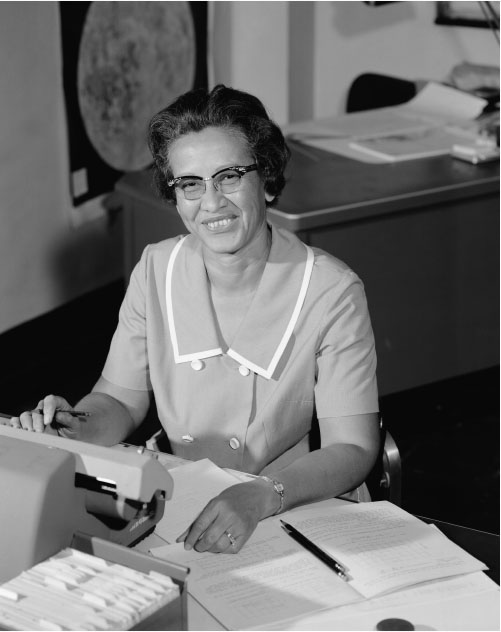
Our histories so far have centered the interests of White American men in computer science. But there are also countless untold, marginalized histories of people of other backgrounds, races, ethnicities, and genders in computing. The book and movie Hidden Figures shares the stories of important Black women who were not only human computers, but also some of the first computer scientists for the early digital computers that powered human spaceflight at NASA (Figure 1.5).
英語のヒント
ここまでの歴史の説明は、コンピューターサイエンスにおける白人のアメリカ人男性の関心を中心に据えてきた。しかし、この分野には、異なる背景、人種、民族、ジェンダーの人々について、語られず、周辺へ追いやられてきた歴史が数え切れないほどある。書籍と映画『Hidden Figures』(映画邦題『ドリーム』)は、人間の計算手であっただけでなく、NASAの有人宇宙飛行を支えた初期のデジタルコンピューターに携わる、最初期のコンピューターサイエンティストでもあった、重要な黒人女性たちの物語を伝えている(図1.5)。
credit: “Katherine Johnson at NASA, in 1966” by NASA/Wikimedia Commons, Public Domain · Public Domain · Source出典
Figure 1.5 Katherine Johnson, a Black computer scientist, recalculated the computations done by early digital computers for space flight planning at NASA. Her contributions were portrayed in the book and movie Hidden Figures. (credit: “Katherine Johnson at NASA, in 1966” by NASA/Wikimedia Commons, Public Domain)
図1.5 黒人のコンピューターサイエンティスト、キャサリン・ジョンソンは、NASAの宇宙飛行計画のために、初期のデジタルコンピューターが行った計算を再計算した。その貢献は書籍と映画『Hidden Figures』に描かれている。(出典:NASA/Wikimedia Commons「Katherine Johnson at NASA, in 1966」、パブリックドメイン)
In one chapter of Black Software, Charlton McIlwain shares stories from “The Vanguard” of Black men and women who made a mark on computer science in its early years from the 1950s through the 1990s through the rise of personal computing and the Internet, but whose histories have largely been erased by the dominant Silicon Valley narratives. Their accomplishments include leading computer stores and developing early Internet social media platforms, news, and blog websites. For example, Roy L. Clay Sr., a member of the Silicon Valley Engineering Hall of Fame, helped Hewlett-Packard develop its first computer lab and create the company’s first computers. Later, Clay provided information to venture capitalists that motivated them to invest in start-ups such as Intel and Compaq.5 In another example, Mark Dean was an engineer for IBM whose work was instrumental in helping IBM develop the Industry Standard Architecture (ISA) bus, which created a method of connecting a computer’s processor with other components and enabling them to communicate. This led to the creation of PCs, with Dean owning three of the nine patents used to create the original PC.6
英語のヒント
チャールトン・マキルウェインは『Black Software』のある章で、黒人男女の「先駆者たち」の物語を紹介している。彼らは1950年代から1990年代にかけて、パーソナルコンピューティングとインターネットが台頭するなか、コンピューターサイエンスの初期の発展に足跡を残した。しかし、その歴史の多くは、支配的なシリコンバレーの物語によって消し去られてきた。彼らの功績には、コンピューター販売店の経営や、初期のインターネット上のソーシャルメディア、ニュース、ブログのWebサイトの開発がある。例えば、シリコンバレー工学の殿堂入りをしたロイ・L・クレイ・シニアは、Hewlett-Packardの最初のコンピューター研究施設の整備と、同社初のコンピューターの開発を支援した。のちには、IntelやCompaqなどの新興企業への投資を促す情報を、ベンチャー投資家に提供した。5もう一つの例は、IBMの技術者マーク・ディーンである。その仕事は、プロセッサーと他の構成要素を接続して通信できるようにするIndustry Standard Architecture(ISA)バスの開発を、IBMが進めるうえで重要な役割を果たした。これがPCの誕生につながり、最初のPCの製造に使われた九つの特許のうち三つを、ディーンが保有していた。6
Yet their efforts were often hampered by the way that computer science failed to center, or even accommodate, Black people. Historically, American Indians and Hispanic people did not have the same access as even Black Americans to computers and higher education. Kamal Al-Mansour, a technical contract negotiator at the NASA Jet Propulsion Lab, worked on space projects while Ronald Reagan was president. He recounts:
英語のヒント
それでも彼らの取り組みは、コンピューターサイエンスが黒人を中心に据えず、受け入れることさえしなかったために、しばしば妨げられた。歴史的に見ると、アメリカ先住民やヒスパニック系の人々は、コンピューターや高等教育を利用する機会において、黒人のアメリカ人にさえ及ばなかった。NASAジェット推進研究所(JPL)で技術契約の交渉を担当したカマル・アルマンスールは、ロナルド・レーガン大統領の時代に宇宙事業に携わった。彼は次のように振り返っている。
“It was conflicting . . . doing a gig . . . supporting missiles in the sky, (while) trying to find my own identity and culture . . . JPL was somewhat hostile . . . and I would come home each day [thinking] What did I accomplish that benefited people like me? And the answer every day would be ‘Nothing.’”7
英語のヒント
「葛藤がありました……仕事として……空を飛ぶミサイルを支える一方で、自分自身のアイデンティティと文化を見つけようとしていたのです……JPLはどこか敵対的な場所でした……毎日家に帰ると、『自分のような人たちの役に立つことを、今日は何か成し遂げたのだろうか』と考えていました。そして毎日、その答えは『何もない』だったのです。」7
Al-Mansour would go on to start a new company, AfroLink, finding purpose in creating software that centered on Black and African history and culture. This story of computer technologies in service of African American communities is reflected in the creation of the Afronet (an early social media for connecting Black technologists) and the NetNoir (a website that sought to popularize Black culture). These examples serve as early indicators of the ways that Black technologists invented computer technologies for Black people in the United States. Yet Black Software also raises challenging political implications of the historical exclusion of Black technologists. Black culture on the Internet has greatly influenced mainstream media and culture in the United States, but these Black cultural products are ultimately driving attention and money to dominant platforms such as X and TikTok rather than those that directly benefit Black people, content creators, and entrepreneurs. Computer technologies risk reproducing social inequities through the ways in which they distribute benefits and harms.
英語のヒント
アルマンスールはその後、AfroLinkという会社を設立し、黒人とアフリカの歴史・文化を中心に据えたソフトウェアを作ることに、目的を見いだした。コンピューター技術をアフリカ系アメリカ人の共同体に役立てるというこの物語は、黒人の技術者同士をつなぐ初期のソーシャルメディアAfronetや、黒人文化を広めようとしたWebサイトNetNoirの誕生にも表れている。これらは、黒人の技術者がアメリカの黒人のためにコンピューター技術を生み出してきた方法を示す、初期の事例である。しかし『Black Software』は、黒人の技術者が歴史的に排除されてきたことの、難しい政治的な意味も問いかける。インターネット上の黒人文化は、アメリカの主流のメディアや文化に大きな影響を与えてきた。ところが、こうした黒人文化の産物が最終的に注目と資金を呼び込む先は、黒人、コンテンツ制作者、起業家に直接利益をもたらす基盤ではなく、XやTikTokといった支配的なプラットフォームである。コンピューター技術は、利益と害の分配のしかたによって、社会の不平等を再生産する危険がある。
The digital divide has emerged as a significant issue, as many aspects of society -- including education, employment, and social mobility -- become tied to computing, computer science, and connectivity. The divide refers to the uneven and unequal access and distribution of technology across populations from different geographies, socioeconomic statuses, races, ethnicities, and other differentiators. While technological access generally improves over time, communities within the United States and around the world have different levels of access to high-speed Internet, cell towers, and functioning school computers. Unreliable electricity can also play a significant role in computer and Internet usage. And beyond systemic infrastructure-based differences, individual product or service access can create a divide within communities. For example, if powerful AI-based search and optimization tools are only accessible through high-priced subscriptions, specific populations can be limited in benefiting from those tools.
英語のヒント
教育、雇用、社会的な地位の移動など、社会の多くの側面がコンピューティング、コンピューターサイエンス、ネットワークへの接続と結びつくにつれ、デジタル格差が重大な問題となっている。これは、居住地域、社会経済的な地位、人種、民族などの違いによって、技術へのアクセスとその分配が偏り、不平等になっていることを指す。技術へのアクセスは全般的には時間とともに改善しているが、アメリカ国内でも世界各地でも、高速インターネット、携帯電話の基地局、学校で正常に動くコンピューターを利用できる程度は、共同体によって異なる。電力供給の不安定さも、コンピューターやインターネットの利用に大きく影響しうる。さらに、インフラに由来する体系的な違いだけでなく、個々の製品やサービスへのアクセスも、共同体の内部に格差を生みうる。例えば、強力なAI検索ツールや最適化ツールが高額な契約でしか利用できなければ、特定の集団はその恩恵を受けることを制限される。
5 J. Dreyfuss, “Blacks in Silicon Valley,” 2011. https://www.theroot.com/blacks-in-silicon-valley-1790868140 6 IBMers, “Mark Dean,” n.d. https://www.ibm.com/history/mark-dean 7 C. D. McIlwain, (2019). Black software: The Internet and racial justice, from the AfroNet to Black Lives Matter, New York: Oxford University Press.
5 J. Dreyfuss「Blacks in Silicon Valley」、2011年。https://www.theroot.com/blacks-in-silicon-valley-17908681406 IBMers「Mark Dean」、発行年不明。https://www.ibm.com/history/mark-dean7 C. D. McIlwain『Black software: The Internet and racial justice, from the AfroNet to Black Lives Matter』、ニューヨーク:Oxford University Press、2019年。