第1章コンピューターサイエンス入門
THINK IT THROUGH考えてみよう
Social Determination of Technology技術の社会的決定論
Do you agree with the social determination of technology? Is it possible for technology—before it is used by people to solve certain problems—to encode social values? Try to come up with an example that would support this belief. What about an example that refutes this belief? What are the social implications of agreeing or disagreeing with the social determination of technology?
英語のヒント
技術の社会的決定論に賛成するだろうか。技術は、人々が特定の問題を解くために使う前から、社会的な価値を組み込んでいる可能性があるだろうか。この考えを支持する例を考えてみよう。反証となる例はどうだろうか。技術の社会的決定論に賛成すること、あるいは反対することは、社会的にどのような意味を持つだろうか。
Today’s neural networks are designed to identify patterns and reproduce existing data. It is widely accepted that many big datasets can encode social preferences and values, particularly when the data is collected from users on the Internet. A social determination of technology accepts this explanation of AI bias and leaves the design of AI algorithms and techniques as neutral: the bias in an AI system is attributed to the social values of the data rather than the design of the AI algorithms. Critics of social determination point out that the way AI algorithms learn from big data represents a social value, one that encodes a default preference for reproducing the biases inherent in big data. This applies whether the AI application is about fair housing, medical imaging, ad targeting, drone strikes, or another topic. This is an issue that computer scientists must consider as they practice responsible computing and strive to ensure that data is gathered and handled as ethically as possible.
英語のヒント
今日のニューラルネットワークは、パターンを見つけ、既存のデータを再現するよう設計されている。特にインターネットの利用者から集めたデータでは、多くの大規模データ集合に社会的な好みや価値観が組み込まれうることが、広く認められている。技術の社会的決定論は、AIの偏りに関するこの説明を受け入れ、アルゴリズムや手法の設計そのものは中立とする。つまり、AIシステムの偏りは、アルゴリズムの設計ではなく、データに含まれる社会的な価値観に由来すると捉える。これに対する批判者は、AIアルゴリズムがビッグデータから学ぶ方法自体が、社会的価値を表していると指摘する。それは、ビッグデータに内在する偏りを再現することを、あらかじめ優先する価値である。AIの用途が公正な住宅供給、医用画像、広告の対象選定、ドローン攻撃、その他の何であっても、このことは当てはまる。コンピューターサイエンティストは、責任あるコンピューティングを実践し、データをできる限り倫理的に集め、扱おうとする際に、この問題を考えなければならない。
Evaluating Negative Consequences of Technology技術の悪影響の評価
Today’s AI technologies work by reproducing existing patterns rather than imagining radically different futures. As much as neural networks are inspired by the human brain, it would be a stretch to suggest that AI systems have any semblance of general intelligence. Though these systems might be quite effective at identifying lettuce plants from weed plants in an image, their capacity for humanlike intelligence is limited by design. A neural network learns to recognize similar patterns that appear across millions or billions of sample images and represent these patterns with millions or billions of numbers. Mathematical optimization methods are used to choose the numeric values that best encode correlations across the sample images. However, current approaches lack a deeper, conceptual representation of objects. One criticism of very large neural networks is that there are often more numeric values than there are sample images—the network can effectively memorize the details of a million sample images by encoding them in a billion numbers. Many of today’s neural networks recognize objects in images not by relying on some intrinsic idea or concept of objects but by memorizing every single configuration of edges as they appear in the sample images.
英語のヒント
今日のAI技術は、根本的に異なる未来を想像するよりも、既存のパターンを再現することで働く。ニューラルネットワークが人間の脳から着想を得ているとはいえ、AIシステムに汎用的な知能らしきものがあるとまで言うのは無理がある。画像中のレタスと雑草を識別することには高い効果を発揮しても、人間のような知能を持つ能力は、設計上制限されている。ニューラルネットワークは、何百万、何十億ものサンプル画像に共通して現れるパターンを学び、それを何百万、何十億もの数値で表現する。数学的な最適化によって、サンプル画像間の相関を最もよく符号化する数値を選ぶ。しかし、現在の手法には、対象をより深く、概念として表現する仕組みが欠けている。非常に大きなニューラルネットワークへの批判の一つは、サンプル画像の数よりも数値の数のほうが多いことがしばしばある、というものだ。100万枚のサンプル画像の細部を10億個の数値に符号化すれば、事実上、丸ごと記憶することができる。現在のネットワークの多くは、物体に固有の考えや概念に頼るのではなく、サンプル画像に現れる輪郭の配置を一つずつ記憶して、画像中の物体を認識している。
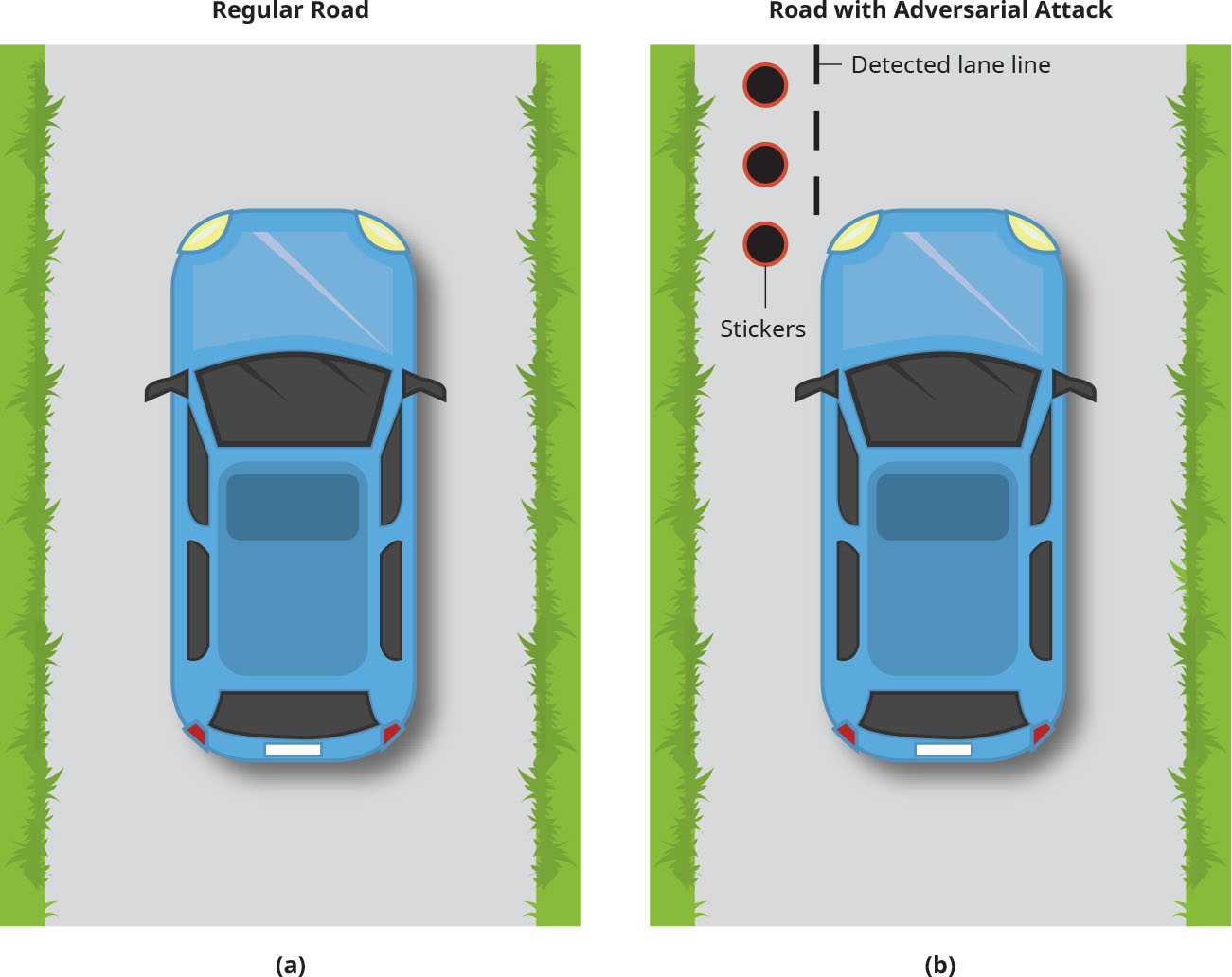
This limitation can lead to peculiar outcomes for image recognition systems. Often, neural network approaches for image recognition have certain examples of images where objects are misidentified in unusual ways: a person’s face might be recognized in a piece of toast or in a bunch of clouds in the sky. In these examples, the pattern of edges might coincidentally trigger the neural network values so that it misidentifies objects. These are among the more human-understandable examples; there are many other odd situations that are less explainable. An adversarial attack is a sample input (e.g., an image) that is designed to cause a system to behave problematically. Researchers have found that even tweaking the color of just a single point in an image can cause a chain reaction in the neural network, leading it to severely misidentify objects. The adversary can choose the color of the point in such a way as to almost entirely control the output of some neural networks: changing a single specific point in an image of a dog might cause the system to recognize the object as a car, airplane, human, or almost anything that the adversary so desires. Moreover, these adversarial attacks can often be engineered to cause the neural network to report extremely high confidence in its wrong answers. Self-driving cars that use neural networks for image recognition can be at risk of real-world adversarial attacks when specially designed stickers are placed on signs that cause the system to recognize a red light as a green light (Figure 1.10). By studying adversarial attacks, researchers can design neural networks that are more robust and resilient to these attacks.
英語のヒント
この限界は、画像認識システムに奇妙な結果をもたらすことがある。例えば、トーストの一片や空の雲の集まりの中に、人の顔を認識してしまうような、通常とは異なる誤認が生じる。輪郭のパターンが偶然ニューラルネットワークの値を反応させ、物体を取り違えるためである。これらは人間にとって比較的理解しやすい例だが、説明しにくい奇妙な状況はほかにも多い。敵対的攻撃とは、システムに問題のある動作をさせるよう設計された、画像などの入力例である。研究者は、画像の一点の色をわずかに変えるだけでも、ネットワークの中で連鎖反応が起き、物体を大きく誤認させられることを発見した。攻撃者は、一部のニューラルネットワークの出力を、ほぼ完全に制御するような一点の色を選べる。犬の画像の特定の一点を変えるだけで、その物体を車、飛行機、人間、あるいは攻撃者が望むほぼ何にでも認識させられることがある。さらに、このような攻撃は、誤った答えについて極めて高い確信度を報告させるよう作り込める場合も多い。画像認識にニューラルネットワークを使う自動運転車も、現実世界の敵対的攻撃の危険にさらされる。標識に特別に設計したステッカーを貼ることで、赤信号を青信号と認識させるような場合である(図1.10)。こうした攻撃を研究すれば、より頑健で、攻撃に耐えるニューラルネットワークを設計できる。
attribution: Copyright Rice University, OpenStax, under CC BY 4.0 license · CC BY 4.0 · Source出典
Figure 1.10 (a) Autopilot functions in self-driving cars generally identify roads and lanes using artificial intelligence to “see” road markings. (b) Researchers were able to trick these cars into seeing new lanes by using as few as three small stickers, to confuse the neural networks and force the cars to change lanes. (attribution: Copyright Rice University, OpenStax, under CC BY 4.0 license)
英語のヒント
図1.10(a)自動運転車の自動操縦機能は、通常、AIで道路の標示を「見る」ことで道路や車線を識別する。(b)研究者は、わずか三つの小さなステッカーでネットワークを混乱させ、別の車線があるように見せかけて、車線変更を強いることができた。(帰属表示:Copyright Rice University, OpenStax、CC BY 4.0)
In general, research is an important part of computer science. Through research, computer scientists analyze ways that technology can be used and gain insight and answers to address issues and improve various aspects of society. Research enables computer scientists to make advancements like the design of new algorithms, development of new hardware and software, and applications for emerging technologies such as AI.
英語のヒント
研究は、コンピューターサイエンスの重要な部分である。研究を通じて、技術の利用方法を分析し、問題への対処や社会のさまざまな側面の改善に役立つ洞察と答えを得る。研究は、新しいアルゴリズムの設計、ハードウェアやソフトウェアの開発、AIなどの新興技術の応用といった進歩を可能にする。
One important use of research is to investigate adversarial attacks to gather answers needed for computer scientists to improve foundational technologies by evaluating the negative consequences of technologies. Computer technologies offer a unique medium for learning things (not just learning computer science), connecting with each other, and enhancing the lives of people all around the world. Yet, in each of these examples, we also raised concerns about how these technologies unfolded and affected people’s lives in both positive and negative ways. While we can rarely, if ever, paint any one technology as purely “good” or “bad,” computer scientists are interested in studying questions around how technologies are designed to center social values. Social scientists are not solely responsible for answering questions about technology, but computer scientists can also contribute important knowledge and methods toward understanding computer technologies.
英語のヒント
研究の重要な用途の一つは、敵対的攻撃を調査し、技術の悪影響を評価することで基盤技術を改善するための答えを集めることである。コンピューター技術は、コンピューターサイエンスだけに限らない学習、人々のつながり、世界中の人の生活の向上に、独特の媒体を提供する。しかし、それぞれの例で、技術がどのように展開され、人々の生活に良くも悪くも影響したかという懸念も見てきた。一つの技術を純粋に「よい」「悪い」と描けることは、仮にあってもまれである。それでも研究者は、社会的価値を中心に据えるよう技術をどう設計するか、という問いに関心を持っている。技術についての問いに答える責任を、社会科学者だけが負うわけではない。コンピューターサイエンティストも、技術の理解に向けて、重要な知識と方法を提供できる。