第10章エンタープライズアーキテクチャーとソリューションアーキテクチャーの管理
LINK TO LEARNING学習へのリンク
The TOGAF Content Framework contains vision, requirements, business architecture, information system architecture, technology, and architecture realization. You can learn more about it by exploring the Content Framework and Enterprise Metamodel (https://openstax.org/r/76OpenGroup) in The Open Group’s official guide. This framework provides an essential structure for managing and aligning IT strategies with business goals.
TOGAFコンテンツフレームワークには、構想、要求、業務アーキテクチャ、情報システムアーキテクチャ、技術、アーキテクチャの実現が含まれる。The Open Groupの公式ガイドにある「コンテンツフレームワークとエンタープライズメタモデル」(https://openstax.org/r/76OpenGroup)を調べると、さらに詳しく学べる。この枠組みは、IT戦略を管理し、事業目標と整合させるために不可欠な構造を提供する。
TOGAF’s foundation architecture sets forth the following:
TOGAFの基盤アーキテクチャは、次のものを定める。
• Architecture building blocks and standards
• アーキテクチャの構成要素と標準
• Generic services and functions to build specific services
• 具体的なサービスを構築するための、汎用的なサービスと機能
• Technical reference model
• 技術参照モデル
• Standards information base
• 標準情報基盤
TOGAF also provides an Enterprise Continuum that addresses the Architecture Continuum and the Solution Continuum, and an Architecture Governance with guidelines relating to the following:
TOGAFはまた、アーキテクチャ連続体とソリューション連続体を扱うエンタープライズ連続体と、次に関する指針を備えたアーキテクチャの統治を提供する。
• Management and control of architecture works at an enterprise level
• 企業水準でのアーキテクチャ作業の管理と制御
• Repositories
• リポジトリ
• Process flow control
• プロセスの流れの制御
• Architecture board, including architecture compliance and contracts
• アーキテクチャへの適合性と契約を含む、アーキテクチャ委員会
• Process and content details (Table 10.3)
• プロセスと内容の詳細(表10.3)
Process プロセス | Content 内容 |
|---|---|
Environment management 環境管理 | Regulatory requirement 規制上の要求 |
Assessment/selection of models, architectures, technologies, and products モデル、アーキテクチャ、技術、製品の評価・選択 | Service-level agreements (SLAs) and online licensure application systems (OLAs) サービスレベル合意(SLA)とオンライン免許申請システム(OLA) |
Dispensation 適用免除 | Authority structures 権限の構造 |
Table 10.3 Process and Content Details of Architecture Governance
表10.3 アーキテクチャの統治におけるプロセスと内容の詳細
Process プロセス | Content 内容 |
|---|---|
Policy management 方針の管理 | Organizational standards and architectures 組織の標準とアーキテクチャ |
Retirement of assets 資産の廃止 | Technology/product set 技術・製品の集合 |
Table 10.3 Process and Content Details of Architecture Governance
表10.3 アーキテクチャの統治におけるプロセスと内容の詳細
CONCEPTS IN PRACTICE概念を実際に使う
EAM Faces New ChallengesEAMが直面する新たな課題
The business of evolving solutions to constantly adapt to change is akin to what people face in real life as they react to change when facing unforeseen situations. This happened recently because of the COVID-19 pandemic. It is not always possible to rely on the current state of a solution and its ability to evolve. Sometimes a leap forward must be made, and it is more important to manage the need to evolve rather than try to adapt an existing, and perhaps obsolete, solution. While it differs from traditional EA techniques, EAM provides a management practice that establishes, maintains, and uses a coherent set of guidelines, architecture principles, and governance regimes that provide direction and practical help in the design and development of an enterprise’s architecture to achieve its vision and strategy. As a result, EAM allows leaps forward to face unexpected changes such as having to innovate to remain competitive rather than simply focusing on being the best at providing a given service.
英語のヒント
変化に絶えず適応するために仕組みを発展させるという仕事は、予期しない状況に直面した人が、実生活で変化に対応するときのことと似ている。最近では、COVID-19の世界的流行によって、そのような事態が起きた。仕組みの現状と、その発展する能力に、常に頼れるとは限らない。時には大きな飛躍が必要であり、既存の、おそらくは時代遅れの仕組みを適応させようとするよりも、発展の必要性そのものを管理することが重要になる。従来のEAの技法とは異なるが、EAMは、一貫した指針、アーキテクチャ原則、統治の仕組みを確立し、維持し、使う管理の実践を提供する。これらが、企業の構想と戦略を実現するアーキテクチャの設計・開発に、方向性と実際的な支援を与える。その結果、EAMは予期しない変化に立ち向かうための飛躍を可能にする。たとえば、あるサービスを提供する点で最高になることだけに集中するのではなく、競争力を維持するために革新する必要がある場合である。
Strategic Adoption Road Map戦略的な導入のロードマップ
EA is typically used by companies to produce a blueprint of the future state and a road map for getting there.
企業は通常、将来の状態の設計図と、そこへ到達するためのロードマップを作るためにEAを使う。
Companies’ shift to lean and flexible operating models directly affects how their IT workforce architects design future business solutions, wherein it needs to enable the new operating model by advancing business capabilities through efficiently integrated and standardized business processes and corresponding solutions. EA ensures the alignment of business architectures with solution architectures by providing a holistic view that links all architecture domains through an enterprise reference architecture (ERA).
英語のヒント
企業が無駄の少ない柔軟な運営モデルへ移行すると、IT人材のアーキテクトが将来の事業向けの仕組みを設計する方法に、直接影響する。効率的に統合・標準化した業務プロセスと、それに対応する仕組みによって事業能力を高め、新しい運営モデルを可能にする必要がある。EAは、エンタープライズ参照アーキテクチャ(ERA)を通じてすべてのアーキテクチャドメインを結ぶ、全体的な見方を提供し、業務アーキテクチャとソリューションアーキテクチャの整合を確保する。
The result of this work, which is produced through an integrated planning process and methodology, aligns and sequences IT investments to optimally achieve the companies’ strategies. The assembly of the road map draws upon three distinct architectural domains:
英語のヒント
統合された計画プロセスと方法論によって生み出すこの作業の成果は、IT投資を整合させ、順序を付け、企業の戦略を最適に実現できるようにする。ロードマップは、次の三つの異なるアーキテクチャドメインを活用して組み立てる。
• Business architecture
• 業務アーキテクチャ
• Business solutions architecture
• 業務ソリューションアーキテクチャ
• IT solutions architecture
• ITソリューションアーキテクチャ
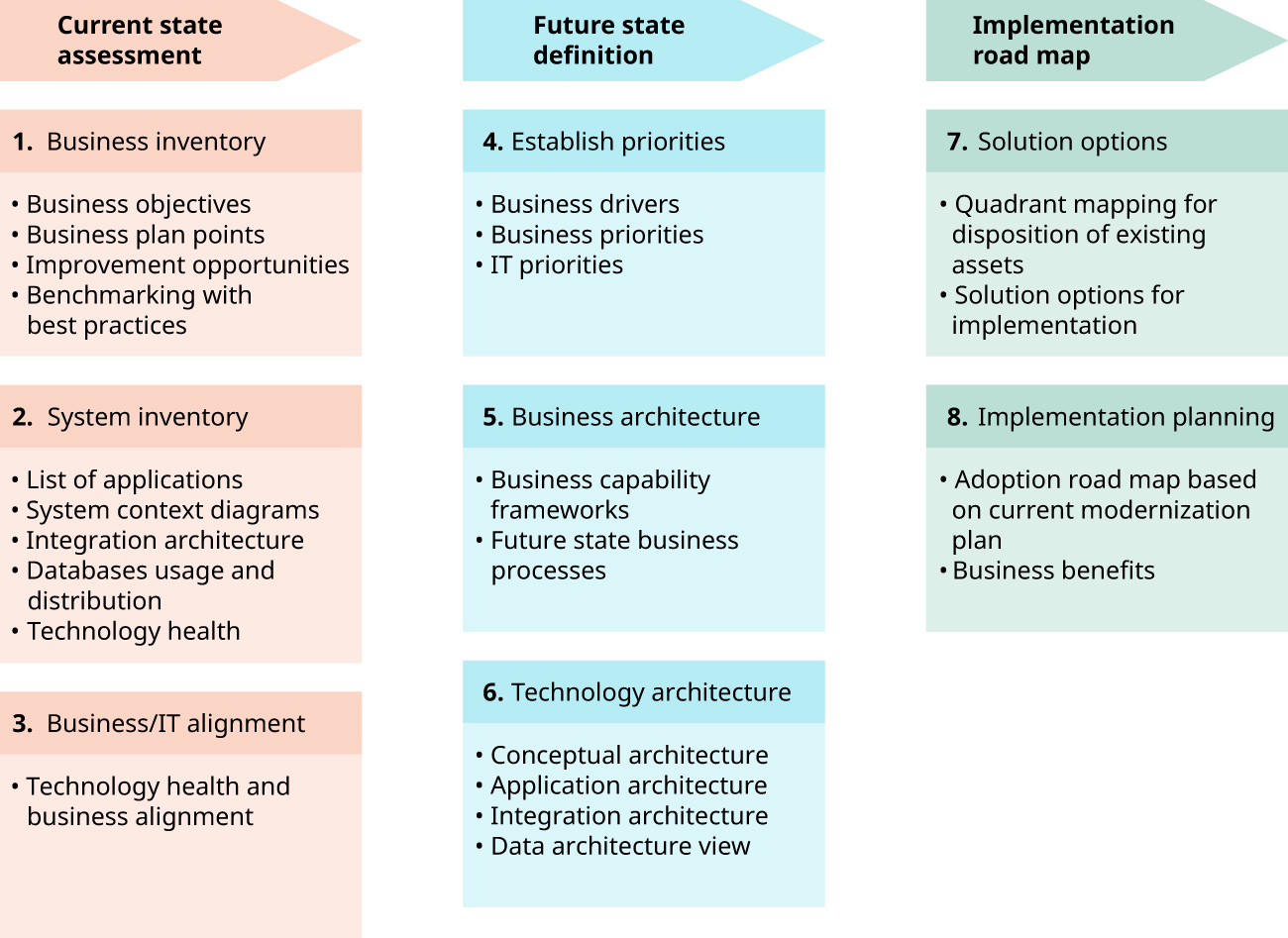
The adoption road map results from implementation planning, as illustrated in step 8 of Figure 10.27. Creating a road map requires a current state assessment, future state definition, and gap analysis.
導入のロードマップは、図10.27の手順8に示すように、実装計画から生まれる。ロードマップの作成には、現状の評価、将来の状態の定義、ギャップ分析が必要である。
attribution: Copyright Rice University, OpenStax, under CC BY 4.0 license · CC BY 4.0 · Source出典
Figure 10.27 These are the steps of adopting a road map. The first step is current state assessment followed by future state definition, and the last step is road map implementation. (attribution: Copyright Rice University, OpenStax, under CC BY 4.0 license)
図10.27 ロードマップを採用する手順。最初は現状の評価で、将来の状態の定義が続き、最後がロードマップの実施である。(帰属:Rice University、OpenStax著作権、CC BY 4.0ライセンス。)
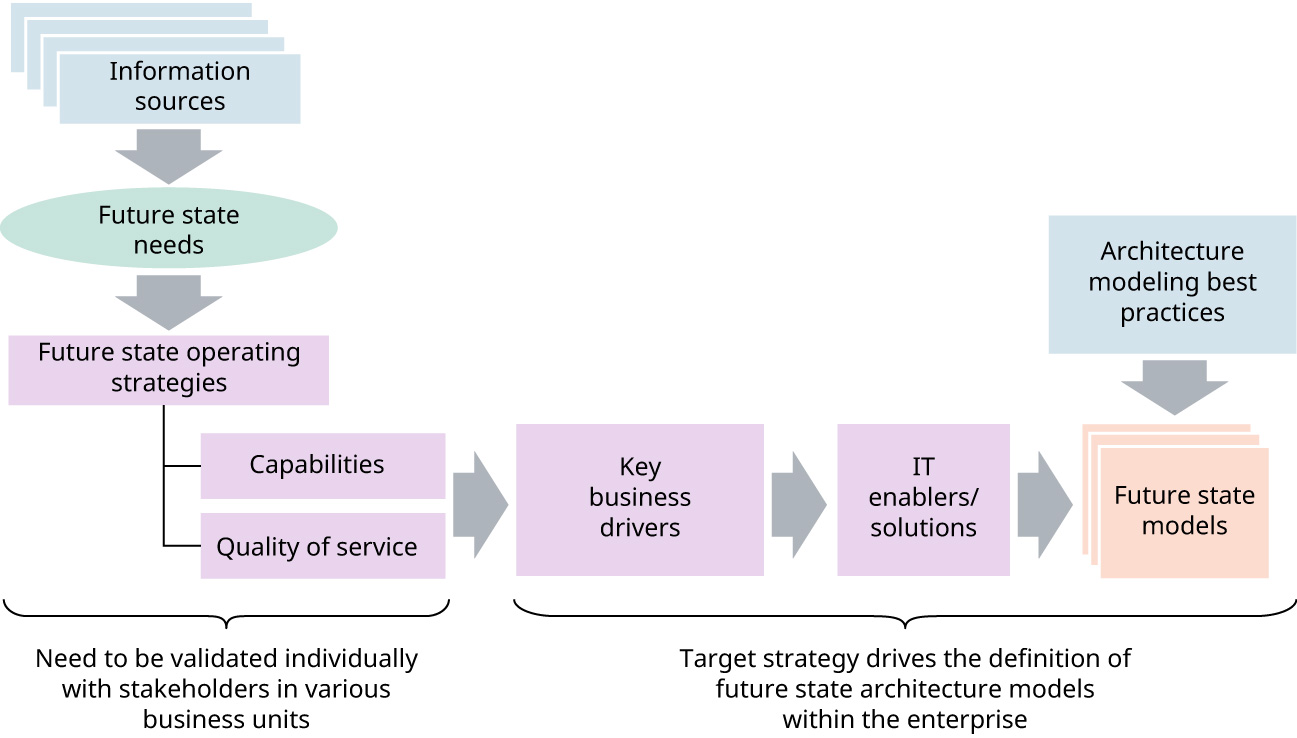
Creating a future state model definition requires an understanding of future state needs and the definition of a target strategy based on various business and IT drivers, as illustrated in Figure 10.28.
将来の状態のモデルを定義するには、図10.28のように、将来の状態で必要なものを理解し、事業とITのさまざまな推進要因に基づいて、目標となる戦略を定めなければならない。
attribution: Copyright Rice University, OpenStax, under CC BY 4.0 license · CC BY 4.0 · Source出典
Figure 10.28 Business and IT drivers define the future state need and how it will be validated by individuals and stakeholders. (attribution: Copyright Rice University, OpenStax, under CC BY 4.0 license)
図10.28 事業とITの推進要因は、将来の状態のニーズと、個人や利害関係者による妥当性確認の方法を定める。(帰属:Rice University、OpenStax著作権、CC BY 4.0ライセンス。)
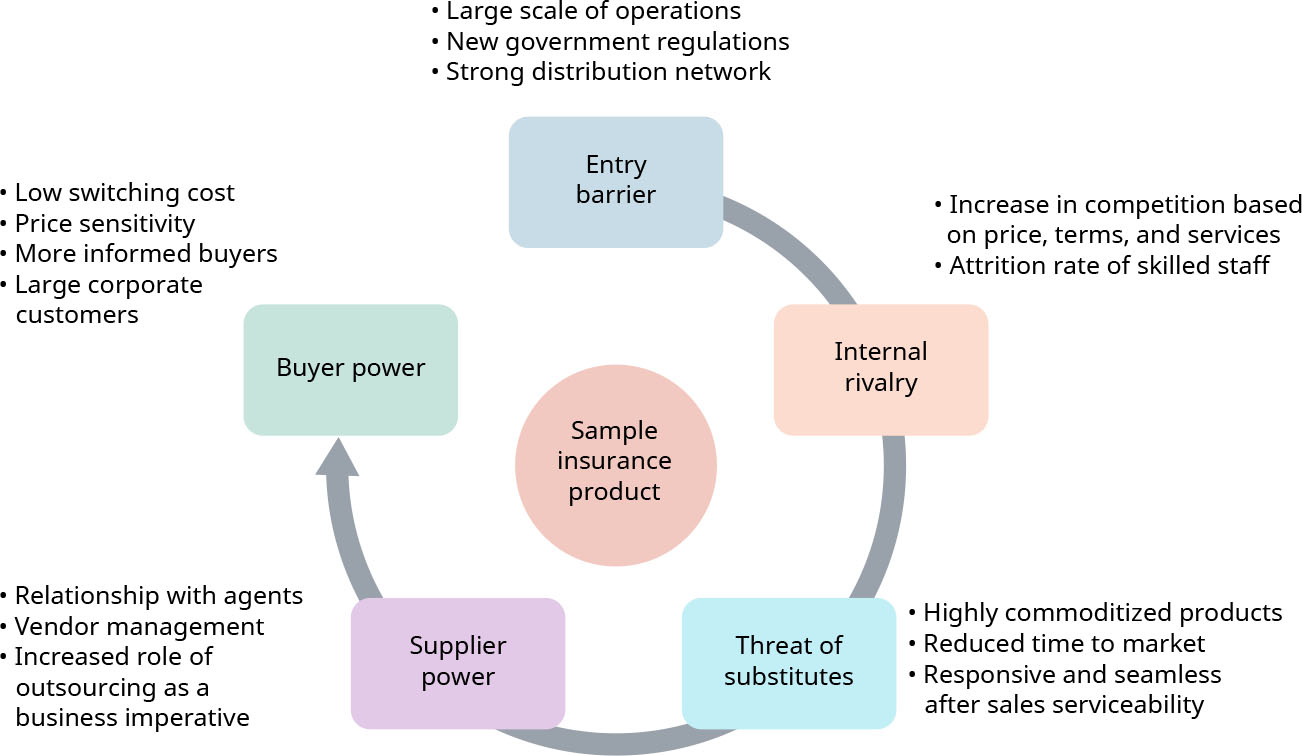
Developing business drivers requires an evaluation of the dynamics of change that are necessary to keep sustaining the business. Businesses often use the five Porter forces illustrated in Figure 10.29 to analyze business dynamics. To ensure that a product competes in the market, you should study these factors: is there any barrier to entering the market? Are there any competitors competing with your product’s price? Is there any threat of substitute products? What is the buyer and supplier power?
英語のヒント
事業の推進要因を定めるには、事業を維持し続けるために必要な、変化の力関係を評価しなければならない。企業はしばしば、図10.29に示すPorterの五つの力を使って、事業の力関係を分析する。製品が市場で競争できるよう、次の要因を調べるべきである。市場への参入障壁はあるか。自社製品の価格と競争する競合相手はいるか。代替製品の脅威はあるか。買い手と供給者の力はどの程度か。
attribution: Copyright Rice University, OpenStax, under CC BY 4.0 license · CC BY 4.0 · Source出典
Figure 10.29 Analyzing business dynamics using the five Porter forces: entry barriers, internal rivalry, threats of substitutions, supplier power, and buyer power. (attribution: Copyright Rice University, OpenStax, under CC BY 4.0 license)
図10.29 参入障壁、内部の競争、代替品の脅威、供給者の力、買い手の力という、Porterの五つの力を使って事業の力関係を分析する。(帰属:Rice University、OpenStax著作権、CC BY 4.0ライセンス。)