第10章エンタープライズアーキテクチャーとソリューションアーキテクチャーの管理
Aligning Business and Technology Strategies事業と技術の戦略を整合させる
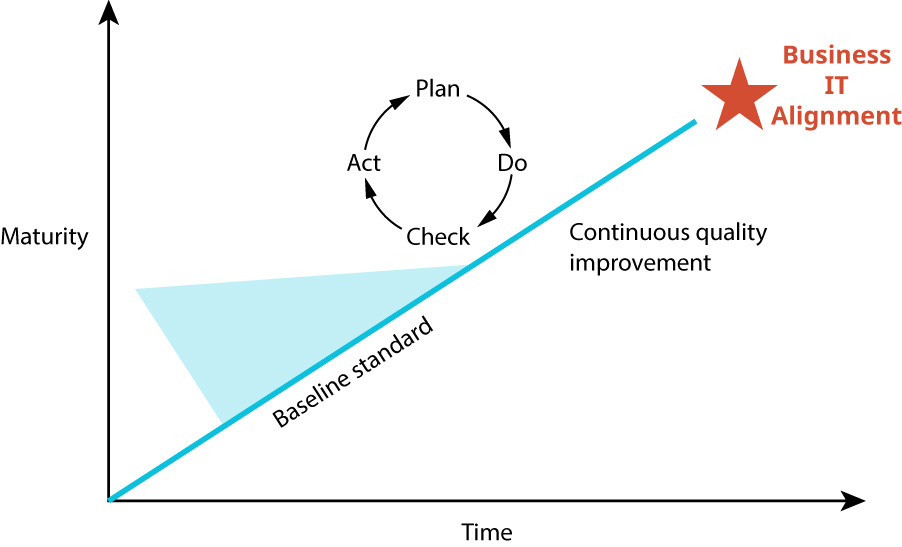
Aligning business and technology strategies is typically difficult on an ongoing basis because of the lack of alignment with enterprise-driven initiatives. Enterprise architecture helps align business and technology strategies, as illustrated in Figure 10.16. This alignment is a continuous process and is achieved through the business-IT alignment life cycle.
英語のヒント
事業と技術の戦略を継続的に整合させることは、通常は難しい。企業主導の取り組みとの整合が欠けているからである。図10.16に示すように、エンタープライズアーキテクチャは、事業と技術の戦略の整合を助ける。これは継続的なプロセスであり、事業とITの整合のライフサイクルを通じて実現する。
attribution: Copyright Rice University, OpenStax, under CC BY 4.0 license · CC BY 4.0 · Source出典
Figure 10.16 The business-IT alignment life cycle is a continuous improvement process that helps align business and technology strategies. (attribution: Copyright Rice University, OpenStax, under CC BY 4.0 license)
図10.16 事業とITの整合のライフサイクルは、事業と技術の戦略を整合させる助けとなる、継続的な改善プロセスである。(帰属:Rice University、OpenStax著作権、CC BY 4.0ライセンス。)
The business IT alignment life cycle helps organizations align their business goals with IT strategies through different stages. The first stage is initiation, which involves checking the problem facing the enterprise or available opportunities. The second stage is strategy, which involves designing solutions. The third stage is planning, which involves planning how to implement the solution. The fourth stage is execution, and it involves implementing the solution. The last stage is assessment, which entails evaluating the solution.
英語のヒント
事業とITの整合のライフサイクルは、複数の段階を通じて、組織の事業目標とIT戦略の整合を助ける。第一は開始の段階で、企業が直面する問題や利用できる機会を確認する。第二は戦略の段階で、解決策を設計する。第三は計画の段階で、実装の方法を計画する。第四は実行の段階で、解決策を実装する。最後は評価の段階で、実装した仕組みを評価する。
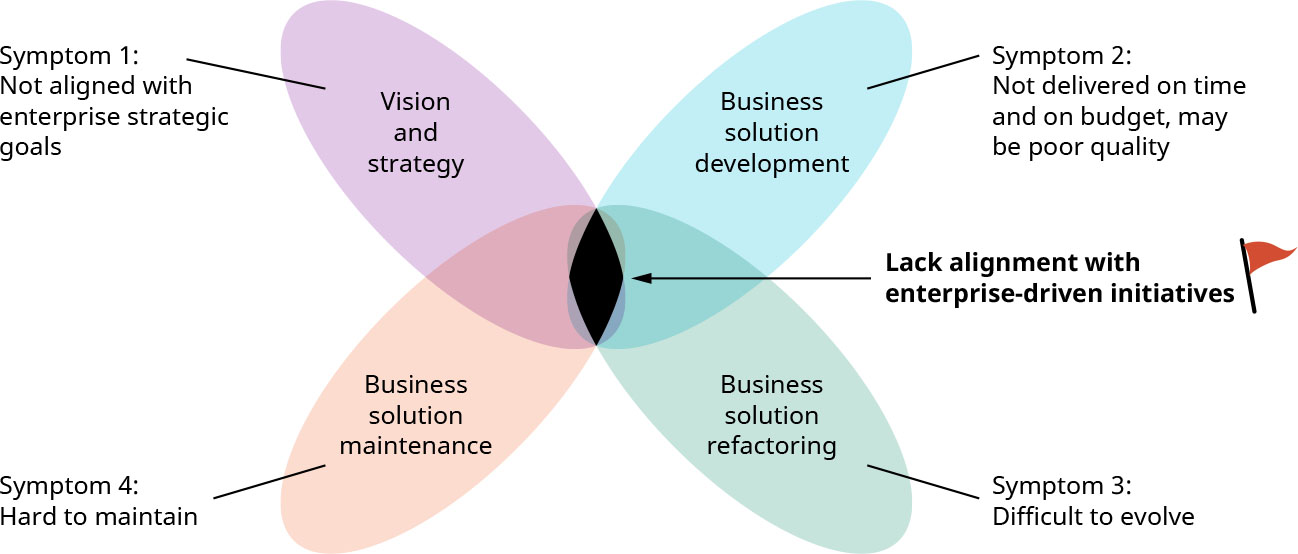
The enterprise team should be careful when developing business IT alignment because enterprise business solutions may lack alignment with the enterprise-driven initiative. In other words, business solutions should take into account the architectural guidelines that are set forth at the enterprise level and not just reinvent the wheel. Figure 10.17 shows the four symptoms that may lead to the lack of alignment.
英語のヒント
企業のチームは、事業とITの整合を進める際に注意しなければならない。企業の事業向けの仕組みが、企業主導の取り組みと整合しない可能性があるからである。言い換えれば、事業向けの仕組みは、企業の水準で定めたアーキテクチャの指針を考慮すべきであり、既存のものを無駄に作り直すだけになってはならない。図10.17は、整合の欠如につながりうる四つの兆候を示す。
attribution: Copyright Rice University, OpenStax, under CC BY 4.0 license · CC BY 4.0 · Source出典
Figure 10.17 When the four symptoms do not overlap, enterprise business solutions lack alignment with enterprise-driven initiatives. (attribution: Copyright Rice University, OpenStax, under CC BY 4.0 license)
図10.17 四つの兆候が重ならないとき、企業の事業向けの仕組みは、企業主導の取り組みとの整合を欠いている。(帰属:Rice University、OpenStax著作権、CC BY 4.0ライセンス。)
The first symptom appears when the created solution is not aligned with the enterprise goal. The second one appears when the business solutions are not delivered on time and on budget or if the outcome doesn’t reach the expected quality. The third one appears when it’s difficult to maintain the system or the solution. The fourth symptom appears when it’s hard to evolve the business solutions.
英語のヒント
第一の兆候は、作成した仕組みが企業の目標と整合していないときに現れる。第二は、仕組みが期日内かつ予算内に提供されないか、成果が期待する品質に達しないときに現れる。第三は、システムや仕組みの保守が難しいときである。第四は、事業向けの仕組みを発展させるのが難しいときに現れる。
GLOBAL ISSUES IN TECHNOLOGY技術をめぐる世界の課題
EAM across the Globe世界各地のEAM
All the EAF frameworks in existence were developed in the United States and Europe. The most widely recognized EAFs are TOGAF (The Open Group Architecture Framework) and the Zachman Framework. EAFs are not typically designed to be adaptable to different organizational contexts and different cultures. Therefore, there is uncertainty about how effective these frameworks are in diverse cultural contexts, such as in Asia and Africa, where decision-making processes and organizational structures may differ from those in the United States and Europe.
英語のヒント
現存するEAFの枠組みは、すべて米国とヨーロッパで開発された。最も広く知られているのは、TOGAF(The Open Group Architecture Framework)とZachmanフレームワークである。EAFは通常、異なる組織の状況や文化に合わせて適応できるようには設計されていない。そのため、意思決定のプロセスや組織構造が米国やヨーロッパと異なりうるアジアやアフリカなど、多様な文化的状況で、これらの枠組みがどれほど有効かは不確かである。
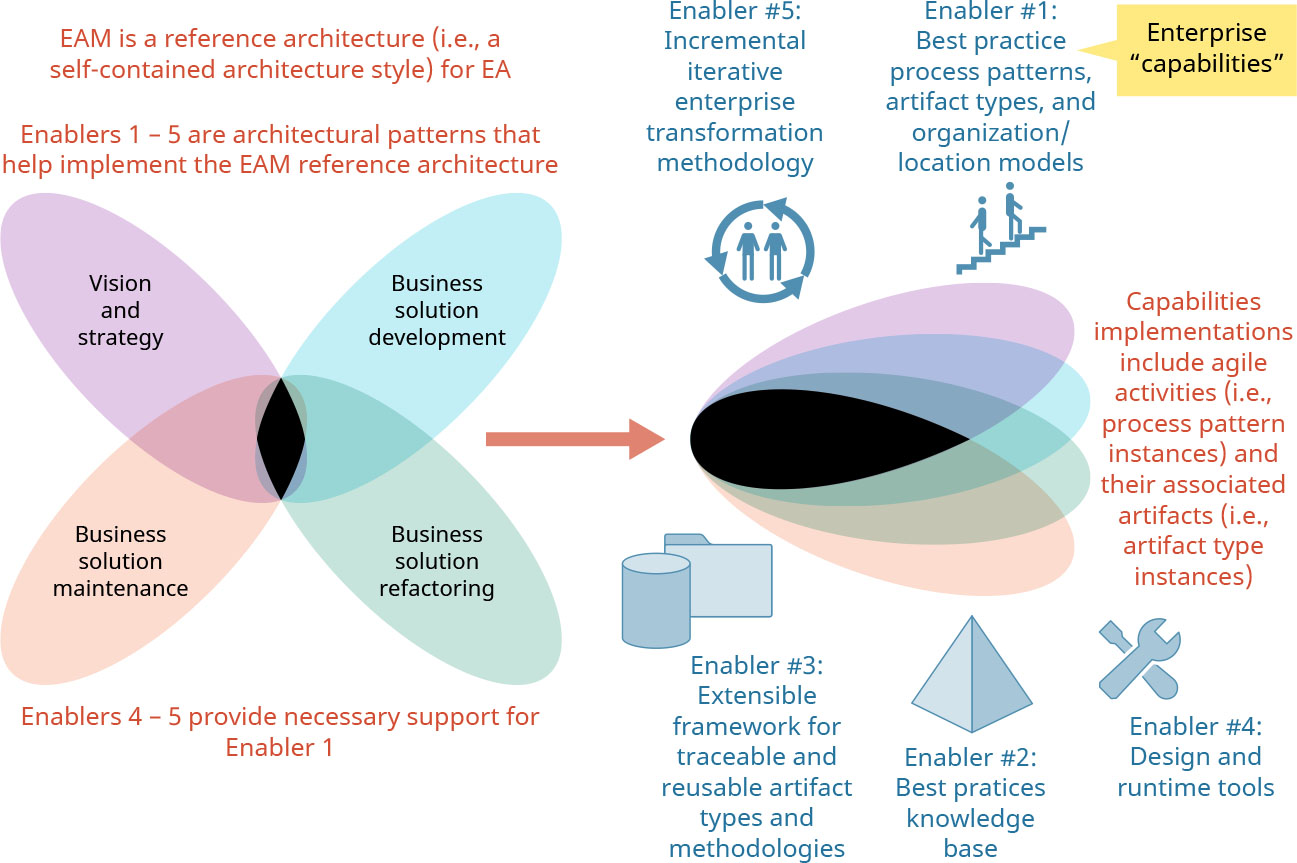
In addition to the alignment, enterprise architecture management uses enablers to provide enterprise capabilities to keep business solutions aligned with the enterprise strategy. An enabler supports the activities needed to extend the architectural runway to provide future business functionality. Figure 10.18 shows five different kinds of enablers, which are listed in Table 10.1.
英語のヒント
attribution: Copyright Rice University, OpenStax, under CC BY 4.0 license · CC BY 4.0 · Source出典
Figure 10.18 Enterprise architecture management provides enterprise capabilities, known as enablers, to keep business solutions aligned with the enterprise strategy. (attribution: Copyright Rice University, OpenStax, under CC BY 4.0 license)
図10.18 エンタープライズアーキテクチャ管理は、事業向けの仕組みを企業戦略に整合させ続けるために、イネーブラーと呼ばれる企業の能力を提供する。(帰属:Rice University、OpenStax著作権、CC BY 4.0ライセンス。)
Type 種類 | Description 説明 |
|---|---|
Best practice process patterns, artifact types, and organization models 優れた実践方法となるプロセスパターン、成果物の種類、組織モデル | Subsumes specific organization and location models within the enterprise along with process patterns and artifact types to guide the implementation of business solutions 企業内の具体的な組織モデルと拠点モデルを、プロセスパターンや成果物の種類とともに包含し、業務上の解決策の実装を導く。 |
Best practice knowledge base 優れた実践方法の知識基盤 | Extensible methodology based on business solution patterns and extensible knowledge foundation; best practices for ongoing strategies and business solution development 事業向けの解決策のパターンと拡張可能な知識基盤に基づく、拡張可能な方法論。継続的な戦略と業務上の解決策の開発のための、優れた実践方法。 |
Extensible framework for reusable artifact types and methodology 再利用可能な成果物の種類と方法論のための、拡張可能な枠組み | Selects subsets of process patterns and artifact types, customizes implementation of process patterns that fit the enterprise environment, and leverages existing enterprise approaches プロセスパターンと成果物の種類の一部を選び、企業環境に合うようにプロセスパターンの実装を調整し、企業の既存の手法を活用する。 |
Design and runtime tools provide necessary support for enabler #1 イネーブラー1に必要な支援を提供する、設計時と実行時のツール | Selects best practice processes, approach, tools, and artifacts to help implement reference architectures 参照アーキテクチャの実装を支援するため、優れた実践方法となるプロセス、手法、ツール、成果物を選ぶ。 |
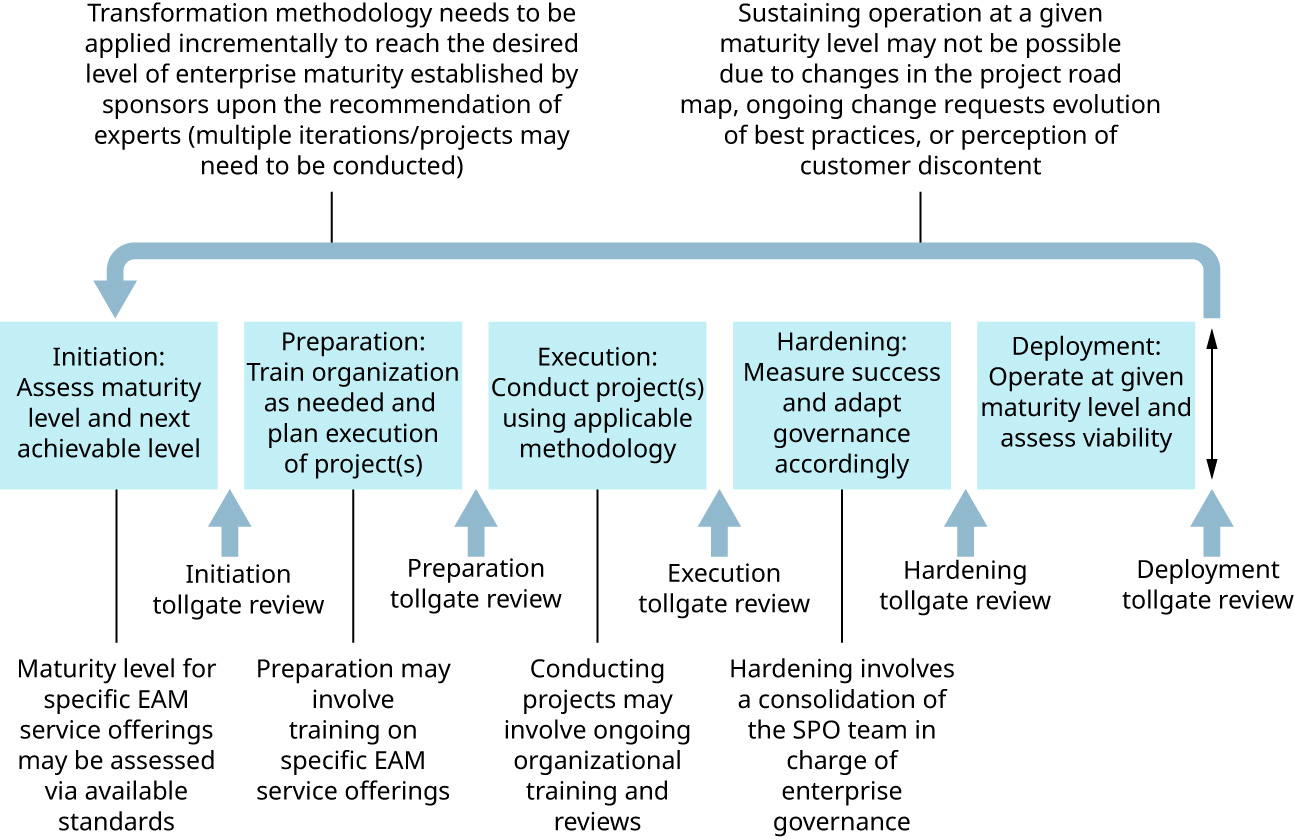
Incremental iterative enterprise transformation methodology 増分的・反復的な企業変革の方法論 | Suggests the use of an incremental iterative (CMMI-compliant) enterprise transformation methodology that improves the maturity of the enterprise, or its ability to keep business and IT aligned over time, as illustrated in Figure 10.19 図10.19に示すように、増分的・反復的な、CMMIに準拠した企業変革の方法論を使うことを提案する。これは、企業の成熟度、すなわち事業とITの整合を長期にわたって保つ能力を高める。 |
Table 10.1 Types of Enablers
表10.1 イネーブラーの種類
attribution: Copyright Rice University, OpenStax, under CC BY 4.0 license · CC BY 4.0 · Source出典
Figure 10.19 This figure shows how the generic EAM Awareness-Desire-Knowledge-Ability-Reinforcement change management methodology applies in the context of a Business Pattern-Driven Modeling process pattern. (attribution: Copyright Rice University, OpenStax, under CC BY 4.0 license)
図10.19 この図は、EAMの汎用的な変更管理方法論である「認識・意欲・知識・能力・定着」を、業務パターン駆動モデリングのプロセスパターンという状況で適用する方法を示す。(帰属:Rice University、OpenStax著作権、CC BY 4.0ライセンス。)